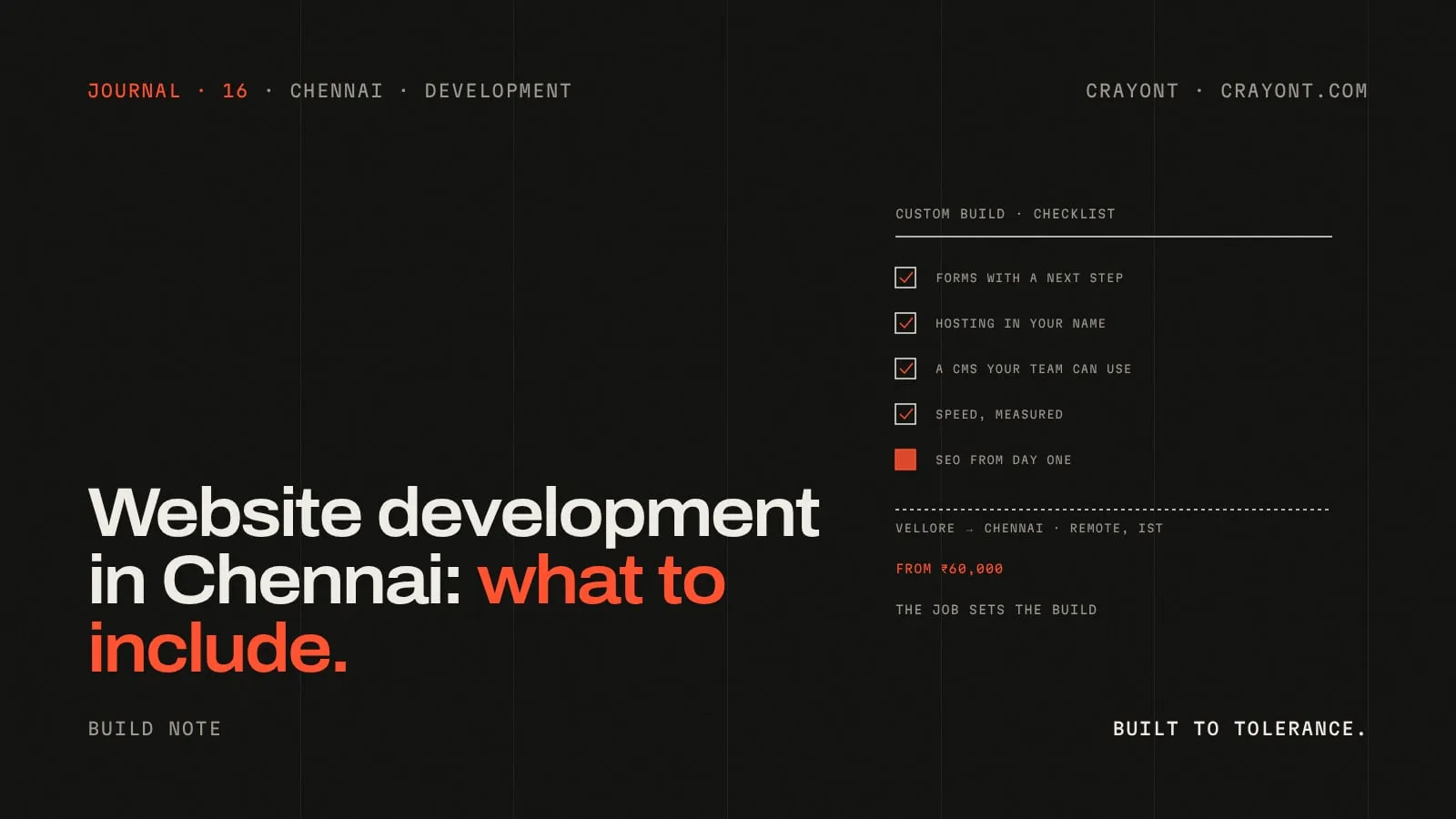
Website development in Chennai: what a custom-built site should include, and a brief you can copy
Hiring a website development company in Chennai? What a custom-coded site should include, what it costs, the questions that matter and a one-page brief you can copy.

- Published
- Reading time
- 6 min
TL;DR · Key takeaways
- Decide what the site has to do before you compare companies: take bookings, sell, collect enquiries or run a portal. That decides the build, and the build decides the price.
- A custom-coded site should come with forms that end in a real next step, hosting in your name, a CMS your team can edit and a measured speed report at launch.
- Our websites start at ₹60,000 and web apps at ₹2,50,000, with the price fixed against a written spec.
- Write a one-page brief before the first call. It gets you comparable quotes and shows which companies actually read it.
Search for a website development company in Chennai and you’ll find hundreds of them, most with the same promises: responsive, SEO-friendly, affordable. That doesn’t help you choose, because it doesn’t tell you what you’ll actually get.
This guide works the other way round. It starts with what your site has to do, lists what a properly built site should include, covers what it costs, and ends with a one-page brief you can send to any company, including us.
Start with the job, not the company
Before you compare anyone, write one sentence: “The website needs to ___.” Most business sites fall into one of these:
| The site needs to… | What that means in the build |
|---|---|
| Get enquiries | Clear pages per service, a short form, WhatsApp and call links that work on a phone |
| Take bookings | A booking flow with dates or slots, confirmation messages and a way for staff to see bookings |
| Sell online | Products, cart, payments (Razorpay or Stripe), order emails, stock and shipping rules |
| Serve existing customers | Logins, a dashboard or portal, documents, connections to the systems you already use |
The first row is a website. The last row is a web app. They’re different jobs with different prices, and a company that quotes for them without asking which one you need is guessing.
What a custom-built site should include
Whatever the job, these are the parts that make a site work for a business. Treat it as a checklist when you compare quotes.
Forms that end in a real next step
A form that sends an email nobody reads isn’t a lead system. A good one checks what people type, confirms on screen what happens next, stores the message safely and tells the right person straight away. If you take bookings, it should offer real slots, not “we’ll get back to you”.
For example, the site we built for MS Family Counselling Center has a three-step call-back booking in English, Urdu and Tamil, with everything people send stored encrypted. That’s the level of detail to expect when the form is the reason the site exists.
Hosting and accounts in your name
The domain, the hosting account, the code and the analytics should belong to you from day one. A lot of trouble in this market starts with a site hosted on the developer’s account, which you then can’t move without their help.
We host on Vercel or Cloudflare accounts you own. If a company won’t put hosting in your name, ask why.
A CMS your team can actually use
Someone on your team will need to change prices, add a blog post or swap a photo. Ask to see the editing screen before you sign. If changing a phone number means emailing the developer, that’s a cost you’ll pay every month.
Speed, measured and written down
Most visitors in Chennai will open your site on a phone, often on mobile data. A slow site loses them before they read anything. Ask the company to agree a speed target in writing and to give you a measured report at launch, not just a screenshot of a Lighthouse score taken on their laptop.
Our Core Web Vitals checklist covers the three numbers Google uses and the limits worth agreeing.
SEO set up properly from the start
That means a real page for each service, proper titles and descriptions, structured data, a sitemap, and Google Search Console connected to your account. If you serve more than one area, it means pages that say so in plain language. None of this is extra work you should pay for later; it’s part of building the site.
Languages, if your customers need them
Many Chennai businesses serve customers in Tamil as well as English. If that’s you, plan it from the start. Adding a second language after launch usually means reworking navigation, forms and SEO.
A handover you can keep
At launch you should get the logins, a short guide for your team, a measured report and a period where bugs are fixed for free. We include a 30-day fix window; after that a care plan is optional.
What it costs
Location doesn’t set the price; scope does. A Chennai company and a Vellore studio quoting the same scope should land in a similar range. Our starting prices:
| What you need | Starting price |
|---|---|
| Website (up to 8 pages, CMS, SEO set-up) | ₹60,000 |
| Website redesign (with a full redirect map) | ₹90,000 |
| 3D or WebGL website | ₹1,50,000 |
| Web app, portal or dashboard | ₹2,50,000 |
| Care plan (monitoring, monthly report, small fixes) | ₹6,000 a month |
The price goes up with the number of pages, booking or payment logic, integrations, languages and how much content needs writing. We break this down further in how much a website costs in India.
Every project gets a written spec first: pages, features, timeline, price and the speed and accessibility targets the site has to meet. The price is fixed against that spec, so it doesn’t creep.
Template, WordPress or custom code?
Quick guide:
- A template or site builder is fine for a simple page you need this week. It gets hard when you want bookings, speed or your own design.
- WordPress suits content-heavy sites with a team used to it. It needs updates and care, and it gets slow when it’s loaded with plugins.
- Custom code (we use Astro for most sites, with a headless CMS) suits sites that need to be fast, take bookings or sell, or connect to other systems.
We compared the three in more detail in Astro vs Webflow vs WordPress.
Questions to ask any website development company
- Who will write the code, and will I talk to them?
- Whose account will the domain and hosting be in?
- Can you show me the editing screen my team will use?
- What speed will the site hit on a mid-range phone, and will you put that in writing?
- How will forms or bookings reach us, and where is that data stored?
- Can I see a live site you built, not just screenshots?
- What is fixed in the price, and what counts as a change?
- What happens after launch if something breaks?
A good company will answer all eight without hesitating. We’ve written a longer version for choosing a design agency in nine questions that separate a studio from a reseller.
A one-page brief you can copy
Send this to every company you’re considering. You’ll get quotes you can compare, and you’ll see quickly who read it.
Business: [name, what you do, where your customers are]
The website needs to: [get enquiries / take bookings / sell / run a portal]
Pages: [list them, roughly]
Must-have features: [forms, booking, payments, languages, logins]
Systems to connect: [WhatsApp, CRM, accounting, payment gateway]
Content: [we have it / we need help writing it]
Who will edit the site: [names or roles]
Speed target: [e.g. usable in under 2 seconds on a mid-range phone]
Budget band: [range]
Launch date: [and why that date]
Current site (if any): [URL, and what's wrong with it]
If you already have a site with traffic, add a line asking how they’ll keep your rankings when the new one goes live. A redesign without a redirect map can lose search traffic overnight; our redirect-map checklist explains why.
How we work with Chennai businesses
We’re Crayont, a two-founder studio in Vellore. Mohammed Riyaz designs and builds the front end; I (Salman) handle the back end, forms, data and integrations. You talk to the two of us, not to a sales team.
Working with Chennai teams is remote and simple: a 30-minute call to start, a written spec, then a live staging link every week and a short written update every Friday until launch. The steps are on our process page.
If you need a site that takes bookings, sells or connects to your systems, see our website development page for Chennai or the full website design and development service. You can look through what we’ve built on the work page, and when you have a brief, even a rough one, send it to us. You’ll get an honest yes, no or “not yet” within a working day.
Questions people ask
- How much does website development cost in Chennai?
- It depends on what the site has to do, not on the city. Our websites start at ₹60,000 for up to eight pages with a CMS and SEO set-up, and web apps such as portals or dashboards start at ₹2,50,000. We fix the price after a written spec.
- Do you work with Chennai businesses even though you're based in Vellore?
- Yes. We're in Vellore, about 140 km from Chennai, and work with Chennai teams remotely: calls when you need them, a live staging link every week and a written update every Friday.
- Should I choose WordPress or a custom-coded site?
- WordPress is fine when a non-technical team needs to edit lots of pages and the site is mostly content. A custom-coded site suits bookings, stores, portals and anything where speed matters. We wrote a longer comparison of Astro, Webflow and WordPress.
- Who owns the website when it's finished?
- You should. The domain, hosting account, code and content should all be in your name from day one. We set up hosting on accounts you own and hand over everything at launch.
- How long does a website take to build?
- A focused business site usually takes a few weeks once the content is ready. Stores, booking systems and web apps take longer. The timeline is written into the spec before work starts.
Keep reading
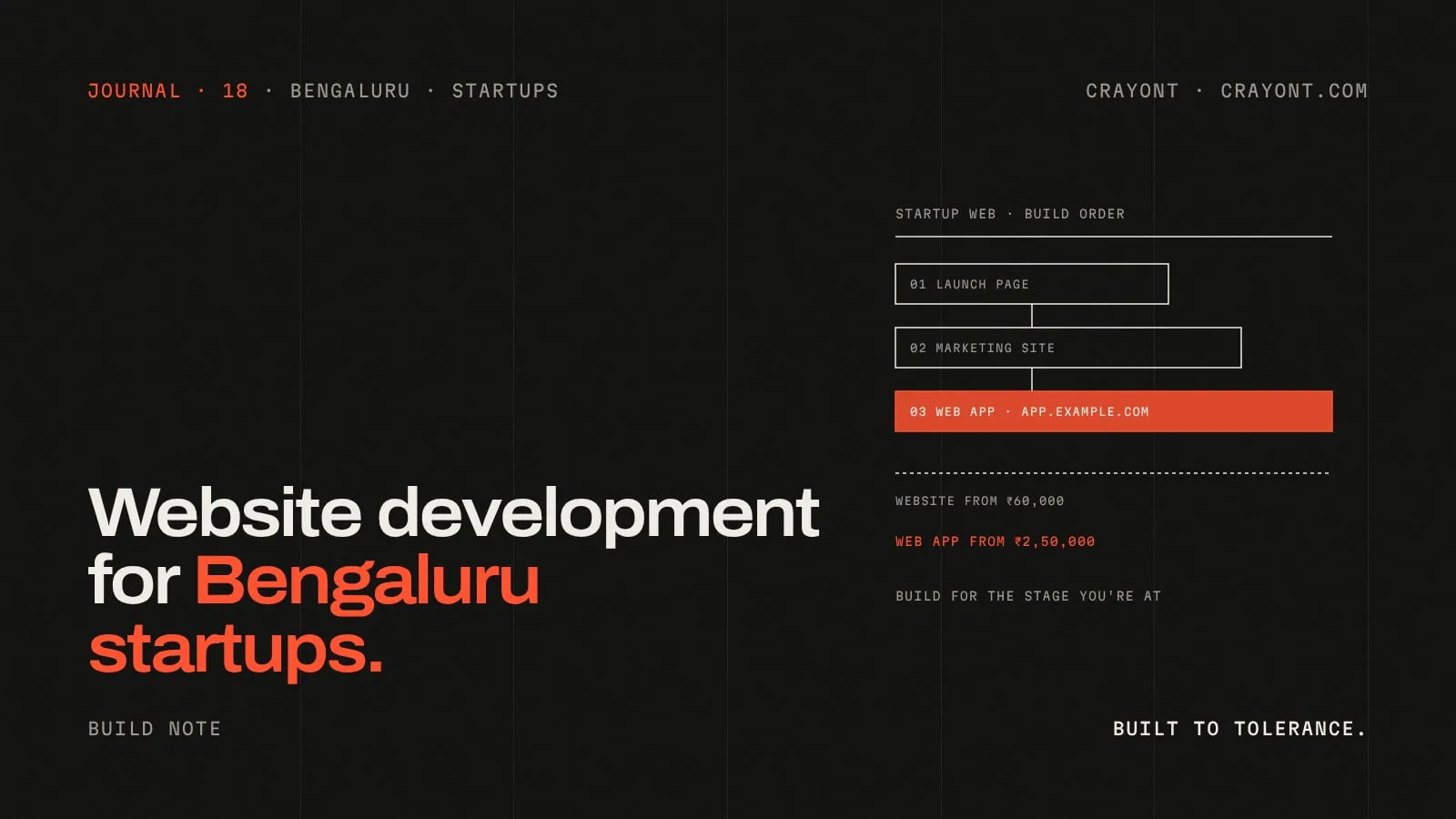
All notes →- Website development for Bengaluru startups: what to build first, and what it costsHiring a website development company in Bengaluru for a startup? What to build at each stage, marketing site vs web app, which stack to pick, what it costs and a brief you can copy.
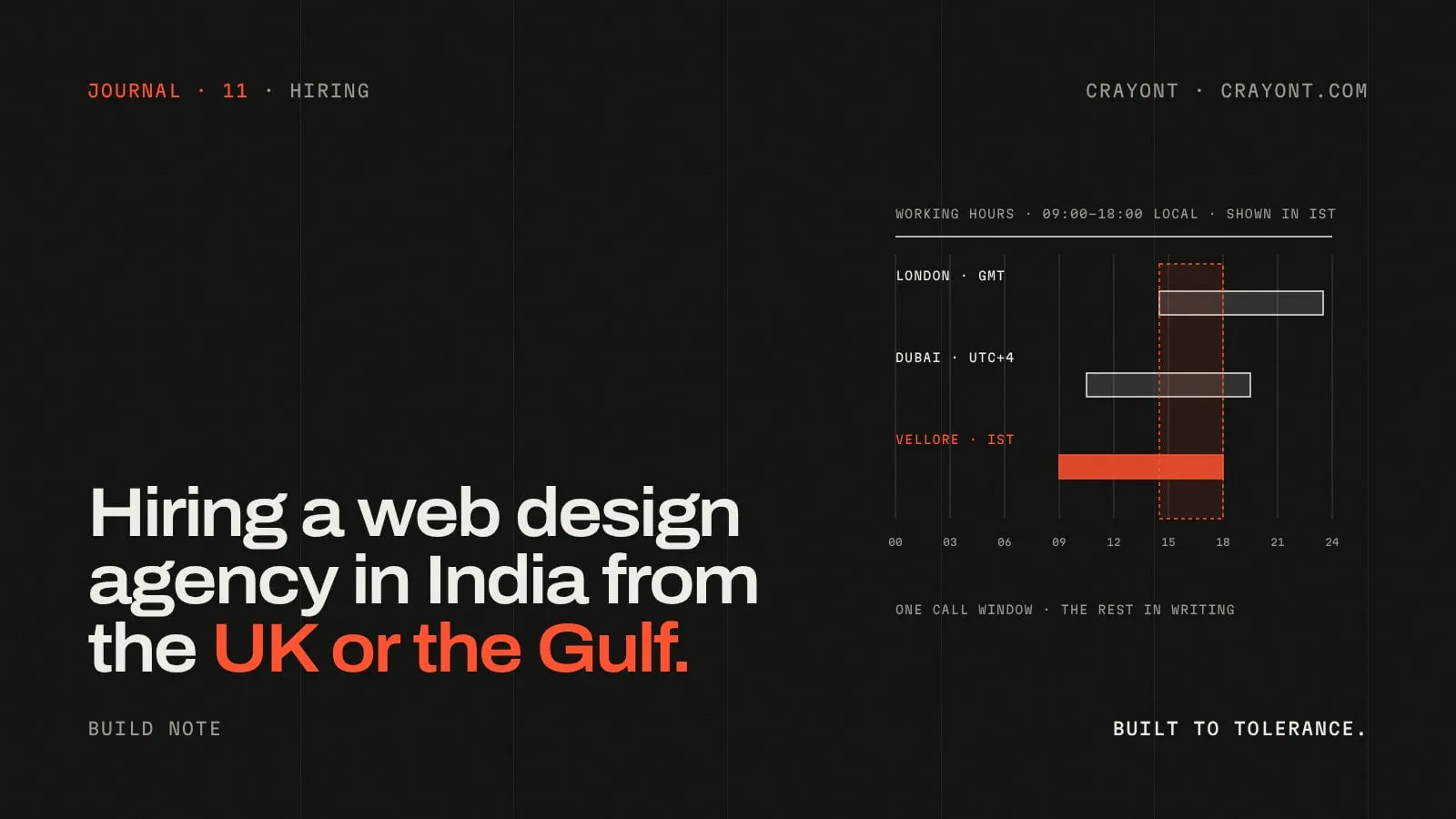
- Hiring a web design agency in India from the UK or the Gulf: what to check firstA practical checklist for UK and Gulf businesses hiring an Indian web design studio in 2026: time zones, contracts, payments, ownership, quality checks and red flags.
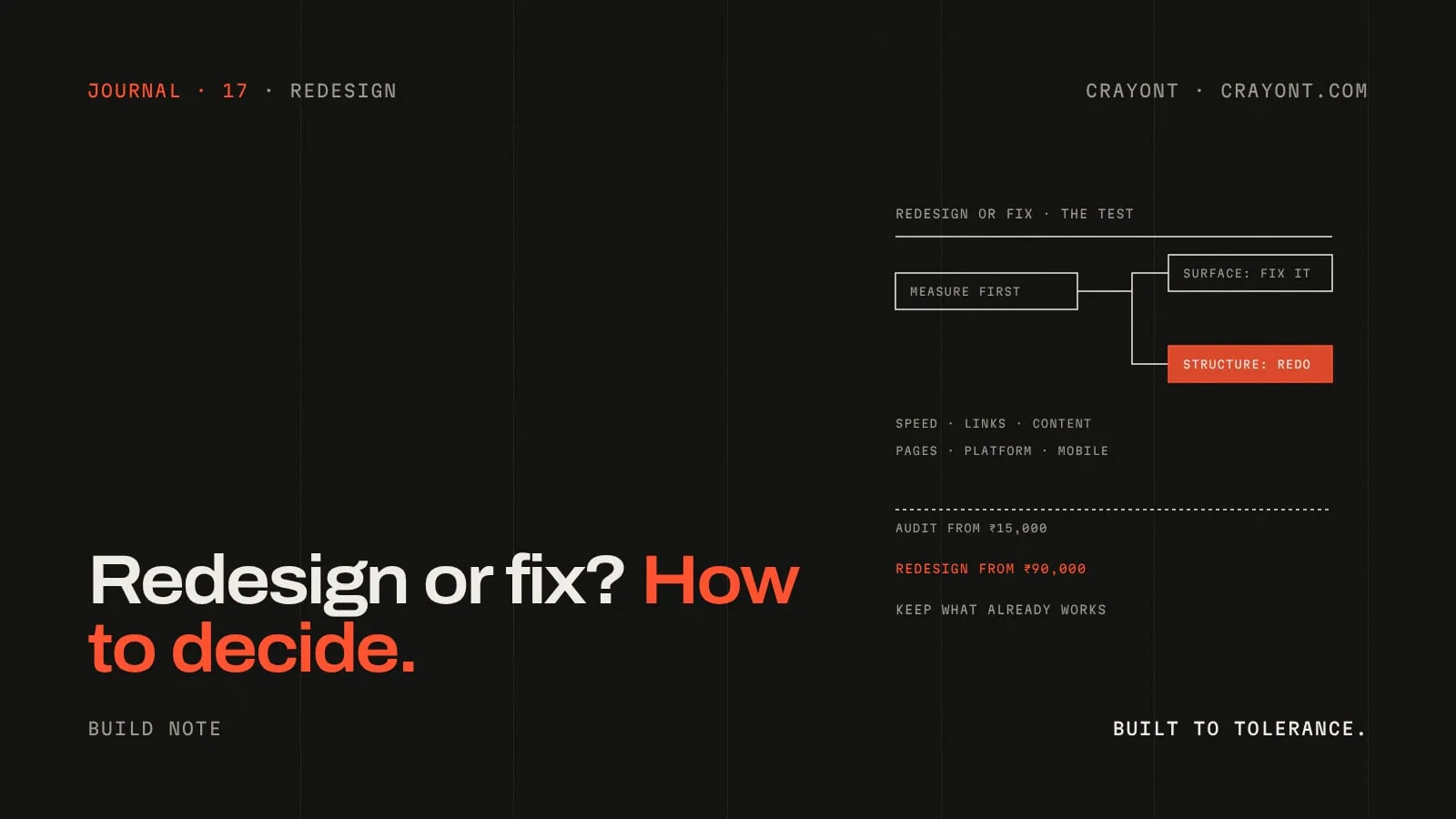
- Redesign or fix? How to tell if your website needs a redesign, and what one costsNot every tired website needs a redesign. A simple test for redesign vs fix, the signs that mean start again, what a redesign costs and how to do one without losing rankings.