Website development for Bengaluru startups: what to build first, and what it costs
Hiring a website development company in Bengaluru for a startup? What to build at each stage, marketing site vs web app, which stack to pick, what it costs and a brief you can copy.

- Published
- Reading time
- 7 min
TL;DR · Key takeaways
- Build for the stage you're at. A pre-launch startup needs one fast page and a waitlist, not a ten-page site and a dashboard.
- Keep the marketing site and the product separate. Marketing should be able to change the site without waiting for an engineering release.
- Pick the stack for who will edit it: Webflow or Astro with a CMS for the marketing site, Next.js or similar for the product.
- Our websites start at ₹60,000 and web apps at ₹2,50,000, fixed against a written spec.
- Own everything from day one: domain, hosting, repository, analytics and the CMS account should all be in the company's name.
Bengaluru has more website development companies than almost any city in India, and most of their pages say the same thing: custom, responsive, scalable, SEO-friendly. None of that helps a founder decide what to actually build, or how much to spend on it before the product has users.
This guide is for startup founders and early teams. It covers what to build at each stage, why the marketing site and the product should be separate, which stack fits which job, what it costs, and a one-page brief you can send to any company, including us.
Build for the stage you’re at
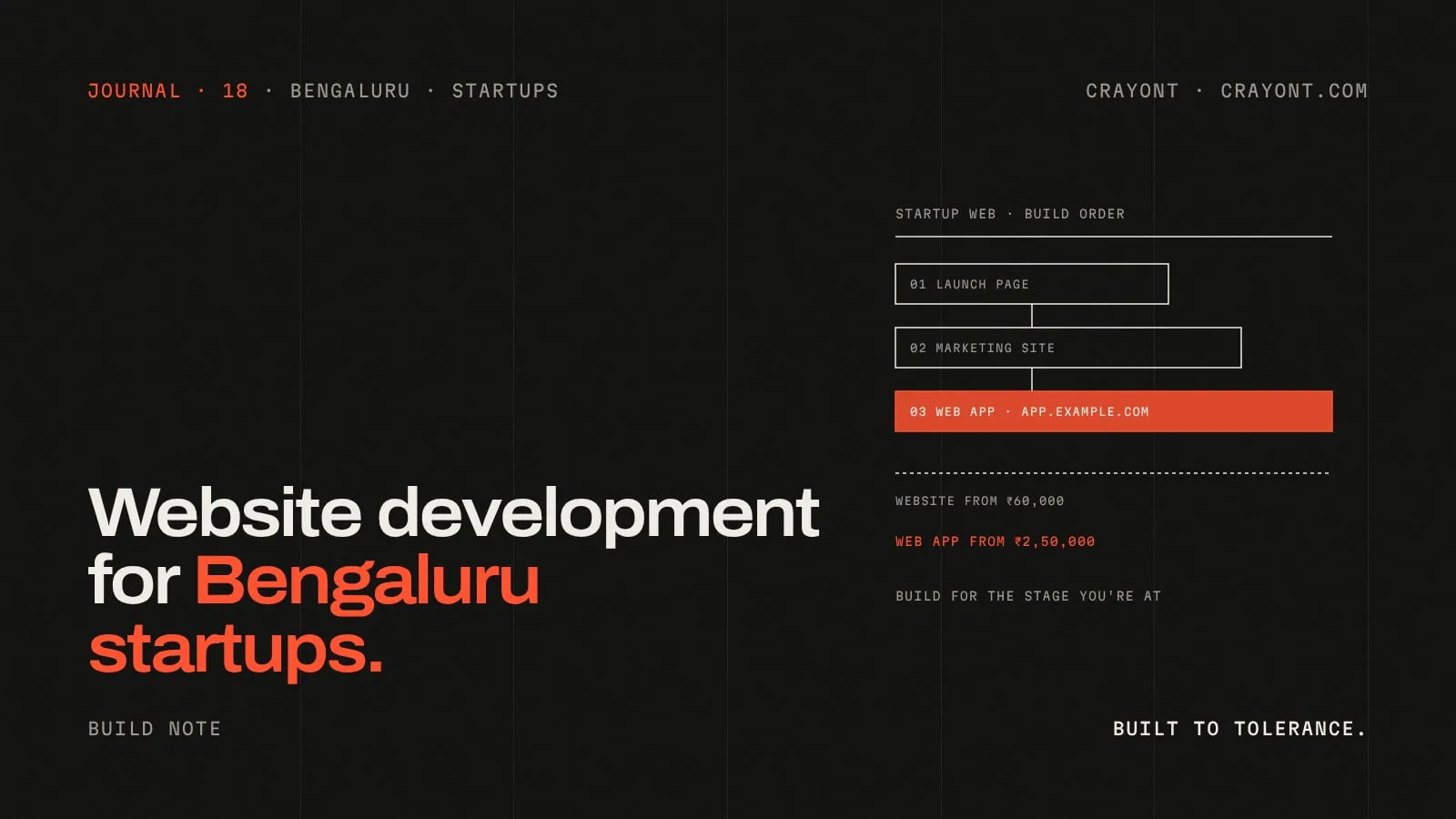
The most common mistake we see is building for the company you hope to be in two years. A pre-launch startup ends up with a ten-page site, a blog nobody writes for and a custom CMS, and still no clear sign-up flow. Match the build to the stage.
| Stage | What you need | What you don’t need yet |
|---|---|---|
| Pre-launch | One fast page: what it is, who it’s for, a waitlist or demo form | A blog, a careers page, case studies |
| Launch | A marketing site: home, product, pricing, about, contact, docs or FAQ | A custom CMS, five languages, heavy animation |
| Growth | Landing pages per use case or segment, a blog, comparison pages, integrations | A rebuild every time you raise |
| Product | The web app itself: logins, dashboards, data, billing | Marketing pages inside the app codebase |
Each stage builds on the last. A well-built launch site should carry you through growth with new pages, not a redesign.
Keep the marketing site and the product apart
Your marketing site and your product have different owners and different speeds.
- The marketing site belongs to whoever runs growth. They need to change a headline, add a landing page or publish a post on the same day, without asking engineering.
- The product belongs to engineering. It ships on a release cycle, with tests and code review.
When both live in one codebase, every copy change waits for a deploy, and every product deploy risks breaking a landing page. The usual set-up that works: the marketing site on the main domain (example.com), the product on a subdomain (app.example.com), both sharing a design system so they look like one company.
Pick the stack for who will edit it
Stack debates waste a lot of early-stage time. The useful question is who will change this, and how often.
Webflow suits a marketing team that wants to edit visually and doesn’t need custom logic. It’s quick to change and hosting is handled. It gets harder when you need speed budgets, complex integrations or full control of the code.
Astro with a headless CMS suits a marketing site that has to be fast and that developers also maintain. Pages ship very little JavaScript, so they load quickly on phones, and the CMS gives non-developers an editing screen. This is what we use for most marketing sites.
Next.js (or a similar React framework) suits the product: logins, dashboards, data tables, billing, anything app-like. It’s also fine for a marketing site if your engineering team wants one stack, as long as someone watches page weight.
We compared the first three in more detail in Astro vs Webflow vs WordPress. If you’re already on Webflow and outgrowing it, our Webflow to Astro migration guide covers what changes.
What a startup website should include
Whatever the stack, these are the parts that decide whether the site does its job.
One clear action per page
Every page should push towards one thing: join the waitlist, book a demo, start a trial. If the homepage has five buttons with five different goals, visitors pick none of them.
Forms that reach a person or a system
A demo request should land in your CRM or a shared inbox within seconds, with the right fields, and the visitor should see what happens next. Test it end to end before launch, on a phone.
Analytics you own
Set up analytics on an account in the company’s name, and decide on the three or four events that matter (sign-up, demo request, pricing page view) before launch, not after. Connect Google Search Console on day one.
Speed, measured
Most visitors, investors included, will open your site on a phone first. Agree a speed target in writing and get a measured report at launch. Our Core Web Vitals checklist covers the three numbers Google uses and the limits worth agreeing.
SEO that matches how people search
That means a page per use case or segment, proper titles and descriptions, structured data and a sitemap. For B2B startups, comparison and alternative pages (“X vs Y”) often bring the most qualified visitors, so plan room for them.
Ownership
The domain, hosting, repository, CMS and analytics accounts should all be in the company’s name from day one. Due diligence will ask, and moving them later is a pain.
What it costs
Location doesn’t set the price; scope does. A Bengaluru company and a Vellore studio quoting the same scope should land in a similar range. Our starting prices:
| What you need | Starting price |
|---|---|
| Website: launch or marketing site (up to 8 pages, CMS, SEO set-up) | ₹60,000 |
| Website redesign (with a full redirect map) | ₹90,000 |
| 3D or WebGL website | ₹1,50,000 |
| Web app, dashboard or SaaS front-end | ₹2,50,000 |
| Care plan (monitoring, monthly report, small fixes) | ₹6,000 a month |
The price goes up with the number of pages and templates, integrations (CRM, billing, product data), languages and how much copy needs writing. For a web app, it’s driven by the number of screens, roles and permissions, and the systems it talks to. We break the general picture down in how much a website costs in India.
Every project starts with a written spec: pages or screens, features, timeline, price and the speed and accessibility targets the site has to meet. The price is fixed against that spec.
Questions to ask any website development company
- Who will write the code, and will I talk to them directly?
- Can you work in our repository, with our pull-request and review process?
- Whose accounts will the domain, hosting and CMS be in?
- How will our marketing team edit pages without a developer?
- What will the site measure on a mid-range phone, and will you put that in the spec?
- How do demo requests and sign-ups reach our CRM?
- What is fixed in the price, and what counts as a change?
- What do we get at handover: docs, tests, a component library?
We wrote a longer version of these for choosing a design agency in nine questions that separate a studio from a reseller.
A one-page brief you can copy
Send this to every company on your list. You’ll get quotes you can compare, and you’ll see who read it.
Company: [name, what you do, who your customers are]
Stage: [pre-launch / launched / growing / building the product]
The site needs to: [collect waitlist sign-ups / book demos / start trials / run the product]
Pages or screens: [list them, roughly]
Must-haves: [CMS, blog, pricing page, logins, billing, docs]
Systems to connect: [CRM, analytics, payments, product API]
Who will edit it: [names or roles]
Stack preference: [Webflow / Astro / Next.js / no preference]
Speed target: [e.g. usable in under 2 seconds on a mid-range phone]
Budget band: [range]
Launch date: [and why that date]
How we work with Bengaluru startups
We’re Crayont, a two-founder studio in Vellore. Mohammed Riyaz designs and builds the front end; I (Salman) handle the back end, data and integrations. You talk to the two of us, not to a sales team, and nobody else writes your code without you knowing.
Work with Bengaluru teams is remote: a call to start, a written spec, then a live staging link every week and a short written update every Friday until launch. For web app work we’re happy to work inside your repository and your tools. The steps are on our process page.
See our website development page for Bengaluru, the full website design and development service or web app development. You can look through what we’ve built on the work page, and when you have a brief, even a rough one, send it to us. You’ll get an honest yes, no or “not yet” within a working day.
Questions people ask
- How much does website development cost for a startup in Bengaluru?
- It depends on what you need at your stage. Our marketing websites start at ₹60,000 for up to eight pages with a CMS and SEO set-up. Web apps, dashboards and SaaS front-ends start at ₹2,50,000. The price is fixed after a written spec, so it doesn't creep.
- Should our marketing site and our product be on the same codebase?
- Usually not. Keeping them apart lets the marketing team change pages without an engineering release, and keeps the product's deploys clean. They can share a design system and a domain (example.com and app.example.com).
- Webflow, Astro or Next.js for a startup website?
- Webflow suits a team that wants to edit visually and doesn't need custom logic. Astro with a headless CMS suits a fast marketing site that developers also maintain. Next.js suits the product itself, where you need logins, data and app-like screens.
- Do you work with Bengaluru startups remotely?
- Yes. We're in Vellore and work with Bengaluru teams remotely: a kick-off call, a written spec, a live staging link every week and a written update every Friday. We can work in your repository and your tools.
- Can you work in our existing codebase?
- Yes. For web app work we often join an existing TypeScript and React codebase. We read it first, agree conventions, and hand back tested, documented changes.
Keep reading
All notes →- Website development in Chennai: what a custom-built site should include, and a brief you can copyHiring a website development company in Chennai? What a custom-coded site should include, what it costs, the questions that matter and a one-page brief you can copy.
- Redesign or fix? How to tell if your website needs a redesign, and what one costsNot every tired website needs a redesign. A simple test for redesign vs fix, the signs that mean start again, what a redesign costs and how to do one without losing rankings.
- How much does a 3D website cost? What actually drives the price of a Three.js siteWhat a 3D or WebGL website costs, the six things that move the price, and how to scope one so you don't pay for 3D nobody sees. With our starting price and process.