Redesign or fix? How to tell if your website needs a redesign, and what one costs
Not every tired website needs a redesign. A simple test for redesign vs fix, the signs that mean start again, what a redesign costs and how to do one without losing rankings.

- Published
- Reading time
- 6 min
TL;DR · Key takeaways
- A redesign is the right call when the problem is the structure: the wrong pages, a platform you can't edit, or a site that no longer says what the business does.
- If the problem is speed, a few broken things or dated content, fix those first. It's faster, cheaper and keeps what already works.
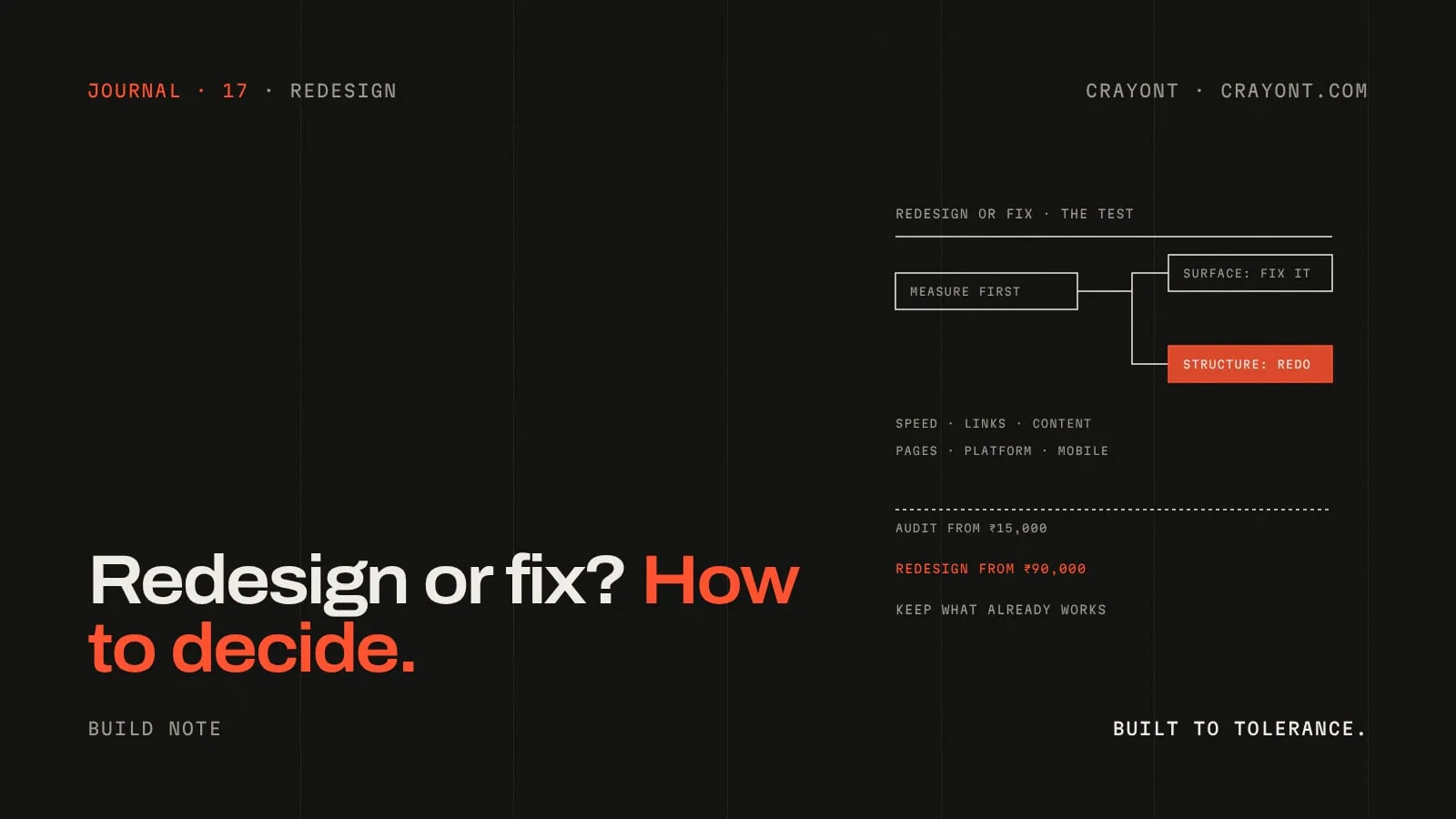
- Measure before you decide: enquiries per month, top pages in Search Console and load time on a real phone. Those numbers tell you what to keep.
- Every redesign needs a redirect map. Without one, the new site can lose the rankings the old one earned.
- Our redesigns start at ₹90,000 and include the audit, the new design and build, and the full redirect map.
Most redesign projects start with a feeling: the site looks old, a competitor launched something new, or someone on the team said it’s embarrassing. That feeling is often right, but it isn’t a plan, and acting on it is how businesses spend months and lakhs on a new site that brings in the same number of enquiries as the old one.
This post is the test I’d run before agreeing to any redesign, including ones people ask us for. Sometimes the honest answer is “fix these five things and keep the site.”
First, measure what you have
Before anyone opens a design tool, get four numbers. They take an afternoon and they decide most of what follows.
- Enquiries per month from the site. Form fills, calls from the site, WhatsApp clicks. If you don’t track these, start now. You can’t judge a redesign without a before.
- Top pages in Google Search Console. The pages that already get clicks from search. These are the ones a redesign must not break.
- Load time on a real phone. Open the site on an ordinary Android phone on mobile data. If it takes more than a few seconds to become usable, you have a speed problem regardless of design.
- How long it takes your team to change something. Ask someone to update a price or add a page. If it needs the developer, that’s a real cost.
Write these down. They’re your baseline, and they’re how you’ll know whether the new site is actually better.
Fix it when the problem is on the surface
Some problems look like “we need a new website” but are really a list of fixes.
| What’s wrong | What usually fixes it |
|---|---|
| The site is slow | Compressing and resizing images, loading fonts properly, removing heavy scripts and plugins |
| Pages jump around while loading | Reserving space for images, banners and embeds |
| Out-of-date content | Rewriting the pages that matter, removing the ones that don’t |
| Broken links and forms | Finding and fixing them, testing every form end to end |
| Weak search presence | Proper titles and descriptions, structured data, a service page per service |
| A dated look on a sound structure | A visual refresh: type, colour, spacing and photography, on the same pages |
None of these needs a new site. A speed and SEO audit finds them, and a developer works through the list. Our Core Web Vitals audit starts at ₹15,000 and comes with a prioritised fix list, and our guides to fixing LCP, CLS and INP cover the most common speed problems step by step.
If your four numbers are fine apart from one or two of these, fix them and spend the rest of the budget on content or marketing.
Redesign it when the problem is the structure
A redesign earns its cost when the problem goes deeper than the surface. These are the signs.
The site describes a business you no longer are. You’ve added services, changed who you sell to, or moved upmarket, and the pages still pitch the old version. Rewriting every page and reorganising the navigation is a redesign whether you call it one or not.
People can’t find what they need. Visitors land on the homepage and can’t work out where to go. Services are buried, pricing is hidden, the contact page is three clicks away. When the page structure is wrong, new paint doesn’t help.
Your team can’t edit it. The site runs on a builder or theme that only the original developer understands, or every change breaks the layout. Moving to a platform with a CMS your team can actually use pays for itself quickly.
It doesn’t work properly on phones. Not “it’s a bit cramped” but menus that don’t open, text you have to zoom to read, buttons too small to tap. If the mobile version was an afterthought, it’s usually cheaper to rebuild than to patch.
The platform is holding you back. You need bookings, payments, a second language or a customer login, and the current setup can’t do it without workarounds. This is where moving to a proper build makes sense; if you’re on Webflow and thinking about it, our Webflow to Astro migration guide covers what changes.
If two or more of these are true, a redesign is probably the right call.
What a redesign costs
Our website redesigns start at ₹90,000. That covers:
- an audit of the current site (traffic, rankings, speed, content);
- a new design and build;
- a full redirect map so rankings carry over;
- a measured report at launch.
The price goes up with the number of pages, the amount of content that needs rewriting, languages, and features such as bookings, payments or logins. For comparison, a new site starts at ₹60,000; a redesign costs more because of the audit and the migration work. We go through the general picture in how much a website costs in India.
As with everything we do, the price is fixed against a written spec, so it doesn’t creep.
How to redesign without losing what works
Most of the risk in a redesign is losing things the old site quietly did well. A careful process protects them.
1. Audit and list what to keep. Pull the pages that get search traffic, the pages that bring enquiries and the content people link to. Everything on that list either stays or moves to a clear new home.
2. Write the spec. Pages, features, speed targets, timeline and price, in writing, before design starts.
3. Design and build on a staging link. You see real pages in a browser every week, not static mockups. Test them on your own phone.
4. Build the redirect map. Every old URL gets mapped to the most relevant new one. This is the step that protects rankings, and it’s the one rushed redesigns skip. Our redirect-map checklist explains how to do it.
5. Measure before launch. Load time, layout shift, responsiveness and accessibility, checked against the targets in the spec.
6. Launch and watch. Submit the new sitemap, watch Search Console for errors and compare enquiries against your baseline for the following weeks.
Questions to ask whoever does your redesign
- What will you keep from the current site, and how did you decide?
- Will you build a redirect map, and can I see it before launch?
- What will the new site measure on a mid-range phone?
- Will my team be able to edit it without you?
- What happens if rankings drop after launch?
- Is the price fixed, and what counts as a change?
If the answer to question 2 is vague, keep looking. That one question separates redesigns that hold their traffic from ones that start again from zero.
Not sure which you need?
Send us your site and we’ll tell you honestly whether it needs a redesign or a fix list. If it’s a fix list, we’ll say so. You can see what we’ve built on our work page, and when you’re ready, get in touch. You’ll get a yes, no or “not yet” within a working day.
Questions people ask
- How do I know if my website needs a redesign?
- If the site no longer matches what you sell, your team can't edit it, it doesn't work properly on phones, or the page structure makes it hard for people to find what they need, a redesign is usually worth it. If the problems are speed, a few broken links or old content, fixing them is usually enough.
- How much does a website redesign cost?
- Our redesigns start at ₹90,000. That covers an audit of the current site, a new design and build, and a full redirect map so your rankings carry over. The final price depends on the number of pages, the content that needs rewriting and any features such as bookings or payments. We fix it after a written spec.
- Will a redesign hurt my Google rankings?
- It can if URLs change without redirects or if pages that rank are removed. A redirect map that sends every old URL to the right new one, plus keeping the content that ranks, protects most of what you've earned. We check Search Console before and after launch.
- How often should a website be redesigned?
- There's no fixed number of years. Redesign when the business has changed or the site can't do what you need. In between, regular fixes and content updates keep it working.
- Can you just fix my site's speed instead?
- Yes. A Core Web Vitals audit starts at ₹15,000 and gives you a prioritised fix list. Many slow sites only need images, fonts and scripts sorted out, not a new design.
Keep reading
All notes →- Website redesign without losing SEO: the redirect-map checklistMost ranking drops after a redesign come from URLs that changed without a redirect. The redirect map I build before launch, how to test it, what to watch.
- How much does a 3D website cost? What actually drives the price of a Three.js siteWhat a 3D or WebGL website costs, the six things that move the price, and how to scope one so you don't pay for 3D nobody sees. With our starting price and process.
- Webflow to Astro migration: what moves, what breaks, what it costsMoving a site from Webflow to Astro: why teams do it, what moves cleanly, what has to be rebuilt, how to keep your rankings, and when to stay on Webflow.