How much does a website cost in India in 2026?
What a website costs in India in 2026, from DIY builders to studios, what moves the price, the hidden yearly costs, and how to compare quotes fairly.

- Published
- Reading time
- 4 min
TL;DR · Key takeaways
- Roughly: a DIY builder costs a subscription, a freelancer site often lands in the tens of thousands of rupees, and a studio or agency build runs from about ₹50,000 into several lakhs. Scope decides where you land, not the city.
- The price moves with the number of unique page templates, the CMS, who writes the content, integrations like payments or booking, 3D, SEO migration and languages.
- Budget for the yearly costs too: domain, hosting, CMS or builder plans, paid plugins and maintenance.
- Compare quotes on a written spec, not a number. Ask what is itemised, what is excluded and what you own at handover.
Short answer: a website in India can cost anything from a few thousand rupees a year on a DIY builder to several lakhs for a custom build. Most small business sites from a freelancer land somewhere in the tens of thousands. Studio and agency builds usually start around ₹50,000 and climb with scope. The city matters far less than what you’re actually asking for.
That range is useless on its own, so here’s what moves the number, what people forget to budget for, and how to compare quotes without guessing.
What moves the price
Number of templates, not pages
Ten service pages that share one layout are cheaper than five pages that each look different. Designers and developers price unique templates: home, service, case study, article, contact. Ask how many templates your site needs, not how many pages.
The CMS
A site you never edit can be static files. A site your team edits weekly needs a content management system, and setting up collections, fields and editor permissions is real work. Some CMS options also carry their own monthly plan.
Content and copy
This is the most underestimated line. If you hand over finished text and photos, the build moves fast. If the studio writes the copy, plans the structure or arranges photography, that’s extra scope, and it’s usually worth it.
Integrations
Payments, booking, CRM forms, WhatsApp, inventory, logins. Each one is a connection to another system that has to be built, tested and kept working. An online store or a booking flow can double a quote on its own.
3D and motion
Interactive 3D, WebGL scenes and scroll-driven motion take design time, modelling and a lot of performance work to load fast on phones. Worth it when it sells the product; a cost line either way.
SEO migration
Replacing an existing site that ranks means a URL inventory, a redirect map and checks after launch. Skip it and you can lose traffic you spent years building. It’s a line item in any honest redesign quote. (More on that in our redirect-map checklist.)
Languages
A multilingual site is not a translation pass. Every template has to handle longer text, language switching and the right search tags for each version.
The market, roughly
Here’s how the Indian market tends to split:
- DIY builders. You pay a monthly or yearly plan and do the work yourself. Cheapest to start, fine for a simple presence, but you’re renting the platform and limited by its templates.
- Freelancers. Often the best value for small sites. Quality varies widely, and continuity is the risk: if they move on, so does the knowledge of your site.
- Small studios. A few people who design and build in-house. Pricier than a freelancer, but you get a process, a spec and the people who did the work on the call.
- Agencies. Larger teams with account managers, broader services and higher overheads. Useful when you need many things at once; check who actually builds your site.
None of these is wrong. The wrong choice is picking a tier that doesn’t match the job.
The costs people forget
The build is one number. Running the site is another, every year:
- Domain. A yearly renewal. Make sure it’s registered in your name.
- Hosting. Anywhere from free tiers for static sites to monthly plans for heavier setups.
- CMS or builder plans. Some platforms charge per site, per editor or per content limit.
- Paid plugins, themes and fonts. Often yearly licences.
- Maintenance. Updates, security fixes, small content changes and someone to call when something breaks.
Ask every quote which of these are included, which are yours to pay and who holds the accounts.
How to compare quotes
- Ask for a written spec. Pages, templates, features, integrations, browsers and devices tested, performance targets. If it isn’t written down, it isn’t in the price.
- Ask for an itemised scope. Design, build, content, SEO migration and integrations as separate lines, so you can see what you’re paying for and what you can cut.
- Ask what’s excluded. Copywriting, photography, stock images, plugin licences and revisions beyond a set number are common exclusions.
- Ask what you get at handover. Code, CMS access, hosting and domain in your name, documentation, and how long fixes are covered after launch.
- Ask for measured results. Load time and Core Web Vitals of recent launches, on a real phone.
Two quotes that answer all five can be compared fairly. Two that don’t are just two numbers.
What Crayont charges
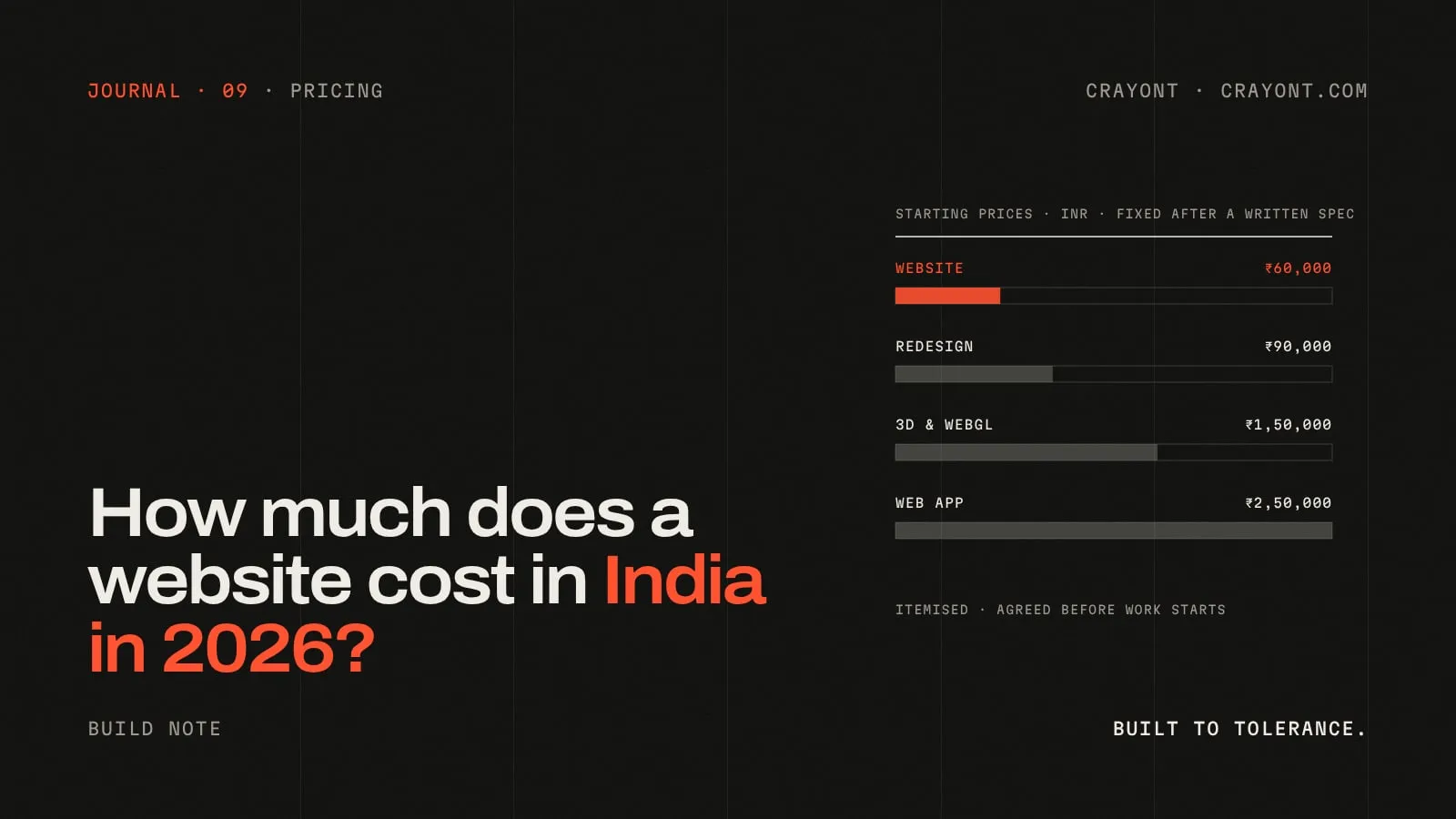
We publish starting prices so you can sanity-check us before a call:
| Service | From |
|---|---|
| Website design & development (new site) | ₹60,000 |
| Website redesign with SEO migration | ₹90,000 |
| 3D & WebGL website | ₹1,50,000 |
| Web app or platform | ₹2,50,000 |
| Core Web Vitals audit with a fix list | ₹15,000 |
| Care plan | ₹6,000 a month |
International clients are quoted in USD, EUR or AED for the same scope. Every project is fixed-price after a written spec, so the number you sign is the number you pay. The full list is on our services page.
We’re based in Vellore and work with clients across India and abroad. If you’re local, our web design page for Vellore has the details.
The honest summary
A website costs what its scope costs. Get the scope written down first, and the price stops being a mystery. If you’d like a spec and a fixed number for yours, tell us what you need.
Questions people ask
- Why do two quotes for the same website differ so much?
- Usually because they are not quotes for the same website. One may be a template with your logo, the other a custom design with content, SEO migration and performance work. Ask both for an itemised scope and compare line by line.
- Is a cheaper website a bad idea?
- Not always. If you need a simple online presence and will edit it yourself, a builder or a good freelancer can be the right call. It becomes expensive when the site has to be rebuilt in a year because it is slow, hard to edit or not owned by you.
- Does Crayont charge differently for clients outside India?
- The scope and the process are the same. International clients are quoted in USD, EUR or AED for the same scope, and every project is fixed-price after a written spec.
- Do I pay monthly or once?
- The build is a one-time, fixed price. Running costs like the domain and hosting are yearly and stay in your name. An ongoing care plan is optional.
Keep reading
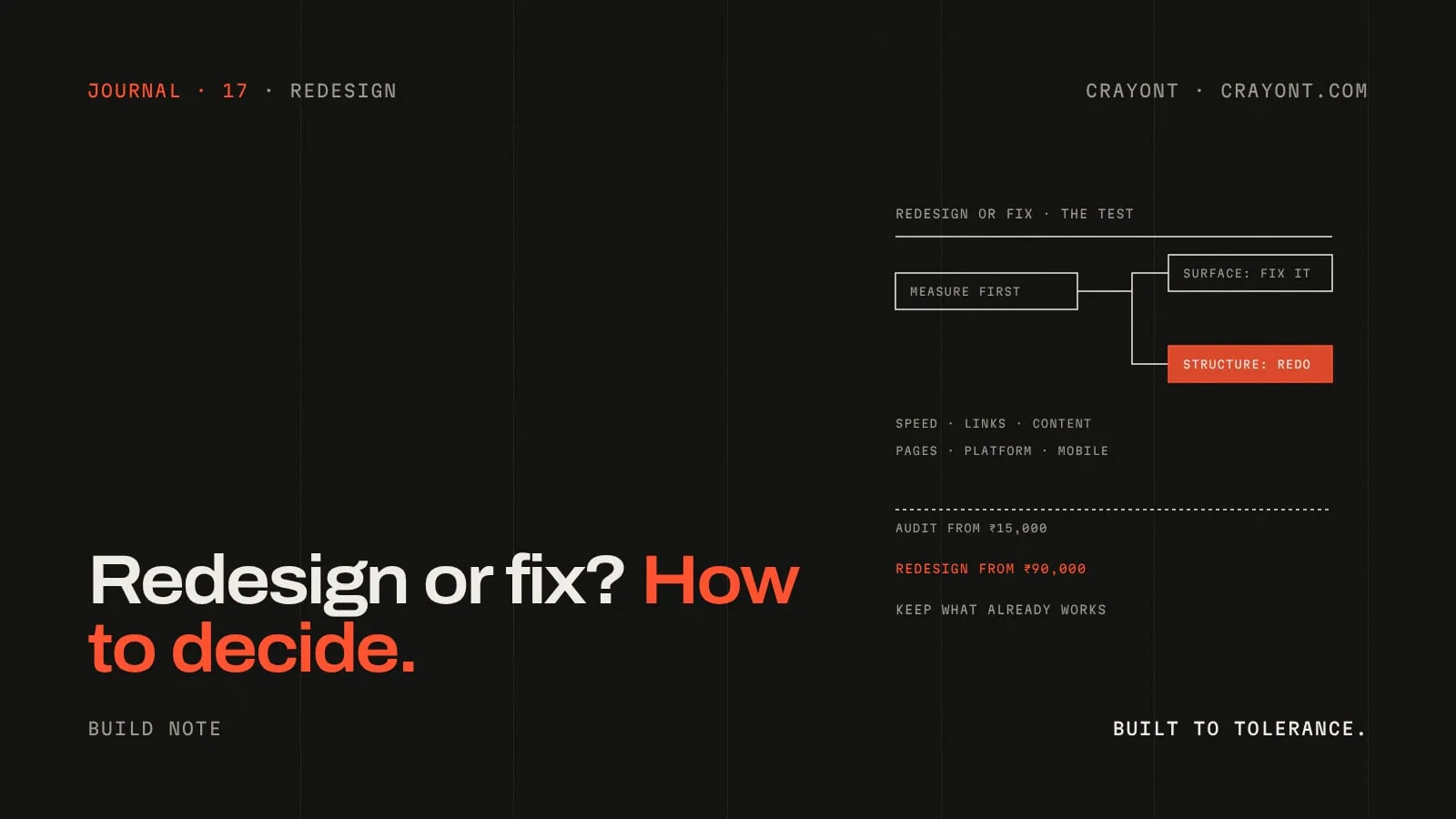
All notes →- Redesign or fix? How to tell if your website needs a redesign, and what one costsNot every tired website needs a redesign. A simple test for redesign vs fix, the signs that mean start again, what a redesign costs and how to do one without losing rankings.
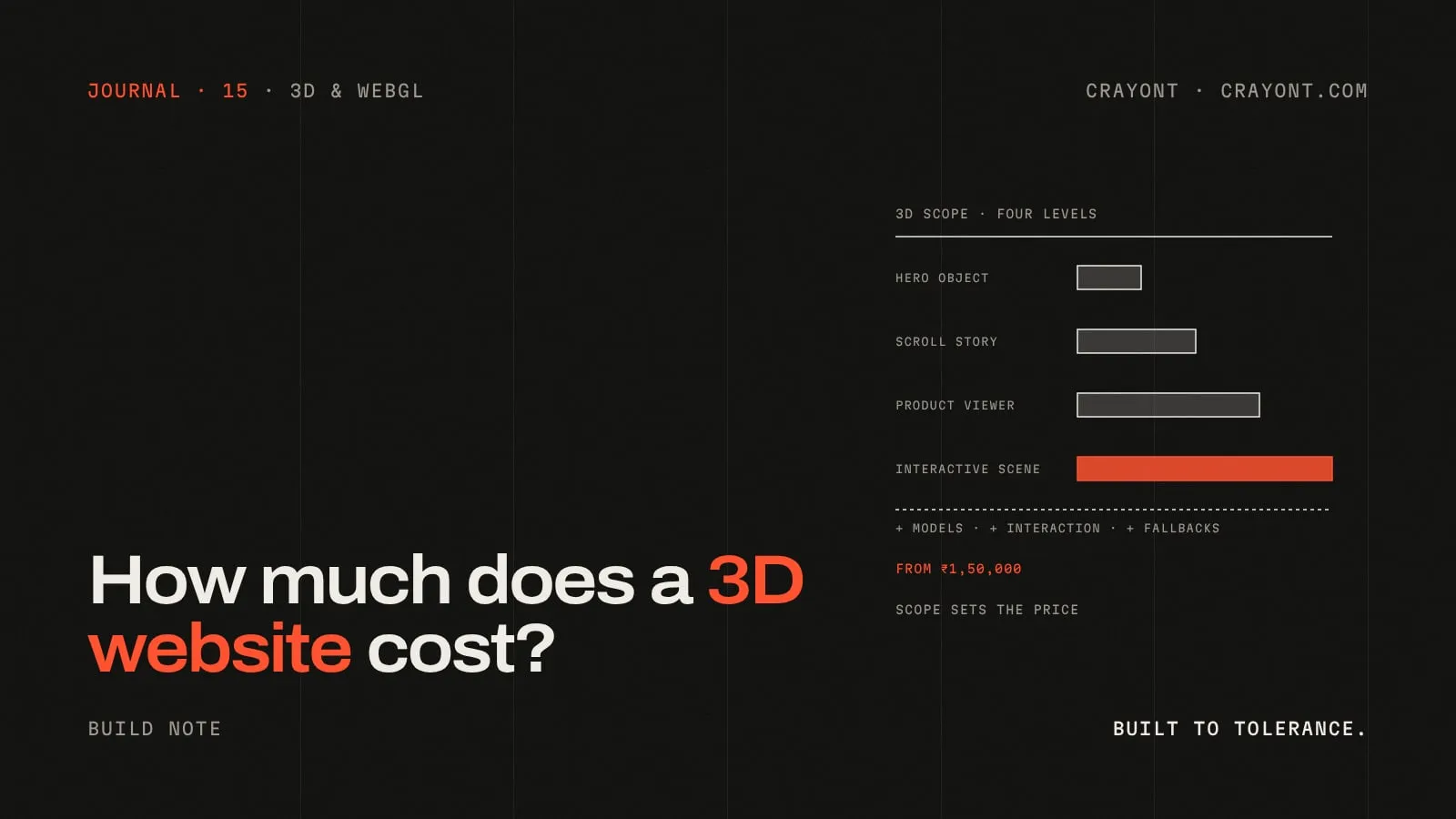
- How much does a 3D website cost? What actually drives the price of a Three.js siteWhat a 3D or WebGL website costs, the six things that move the price, and how to scope one so you don't pay for 3D nobody sees. With our starting price and process.
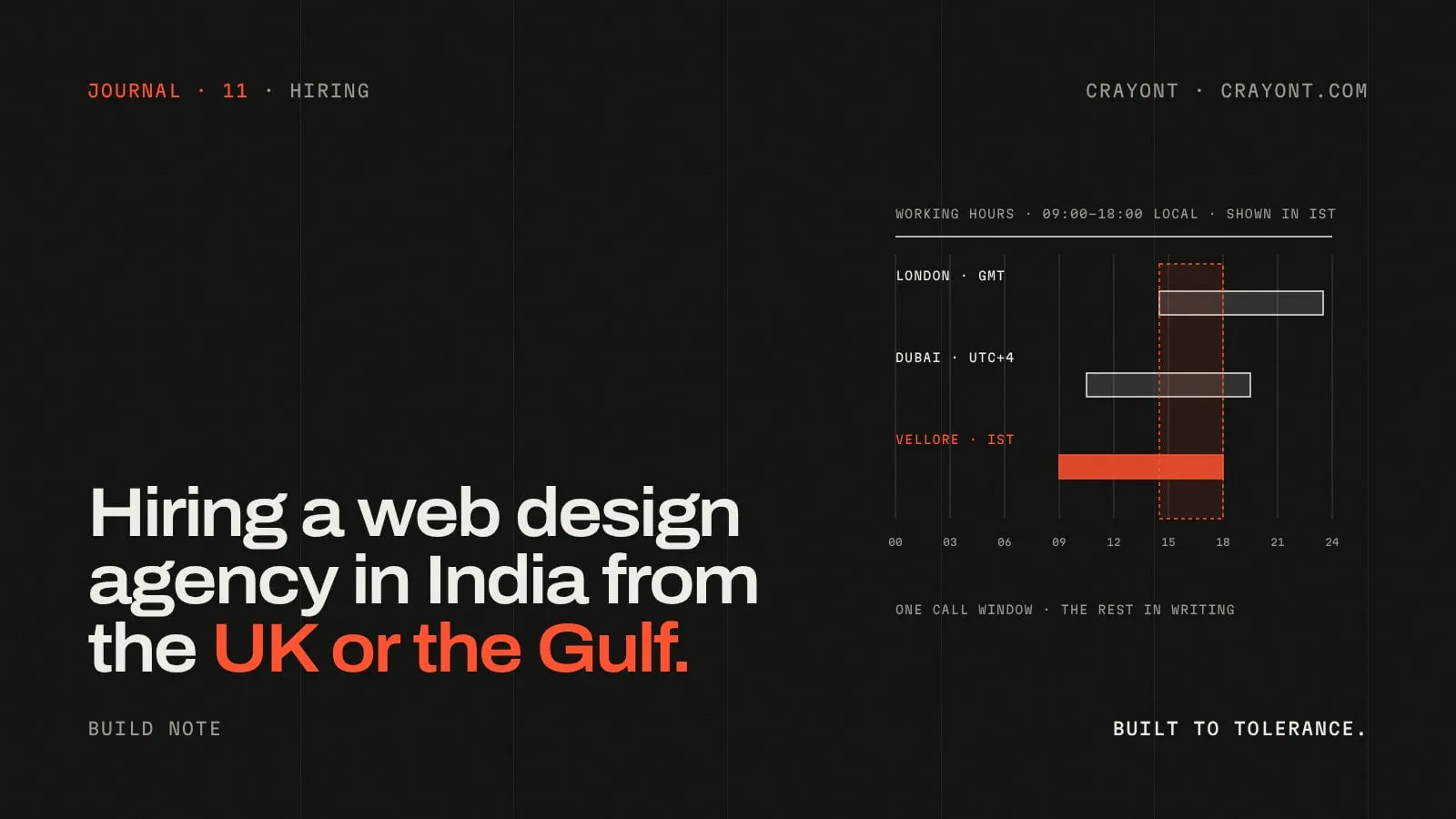
- Hiring a web design agency in India from the UK or the Gulf: what to check firstA practical checklist for UK and Gulf businesses hiring an Indian web design studio in 2026: time zones, contracts, payments, ownership, quality checks and red flags.