How much does a 3D website cost? What actually drives the price of a Three.js site
What a 3D or WebGL website costs, the six things that move the price, and how to scope one so you don't pay for 3D nobody sees. With our starting price and process.

- Published
- Reading time
- 6 min
TL;DR · Key takeaways
- A 3D website is a normal website plus a 3D layer. You pay for both, so the 3D layer should earn its place on the page.
- Scope sets the price more than anything else: one hero object, a scroll story, a product viewer and a full interactive scene are four very different jobs.
- Models are the hidden cost. Geometry built in code is cheap; a detailed product model, scanned object or animated character is a project of its own.
- Budget for the fallback. Every 3D scene needs a finished static version for slow phones, reduced motion and search engines, and that takes real design time.
- Our 3D and WebGL websites start at ₹1,50,000, with the final price fixed after a written spec.
You’ve seen a site where a product turns as you scroll, or the background is a scene you can move through, and now you want one. The first question is always the same: what does it cost?
The honest answer is that “a 3D website” covers everything from one spinning object in a hero to something closer to a small game. Those jobs differ by a lot. This guide explains what moves the price, so you can scope a 3D site that does its job without paying for effects nobody notices.
A 3D website is two projects
Every 3D website is a normal website (pages, text, navigation, forms, SEO, a CMS) with a 3D layer on top. You pay for both.
The normal part costs what any good site costs. We covered that in how much a website costs in India. The 3D layer is extra, and its price depends on the six things below.
The six things that set the price
1. Scope: how much 3D, and where
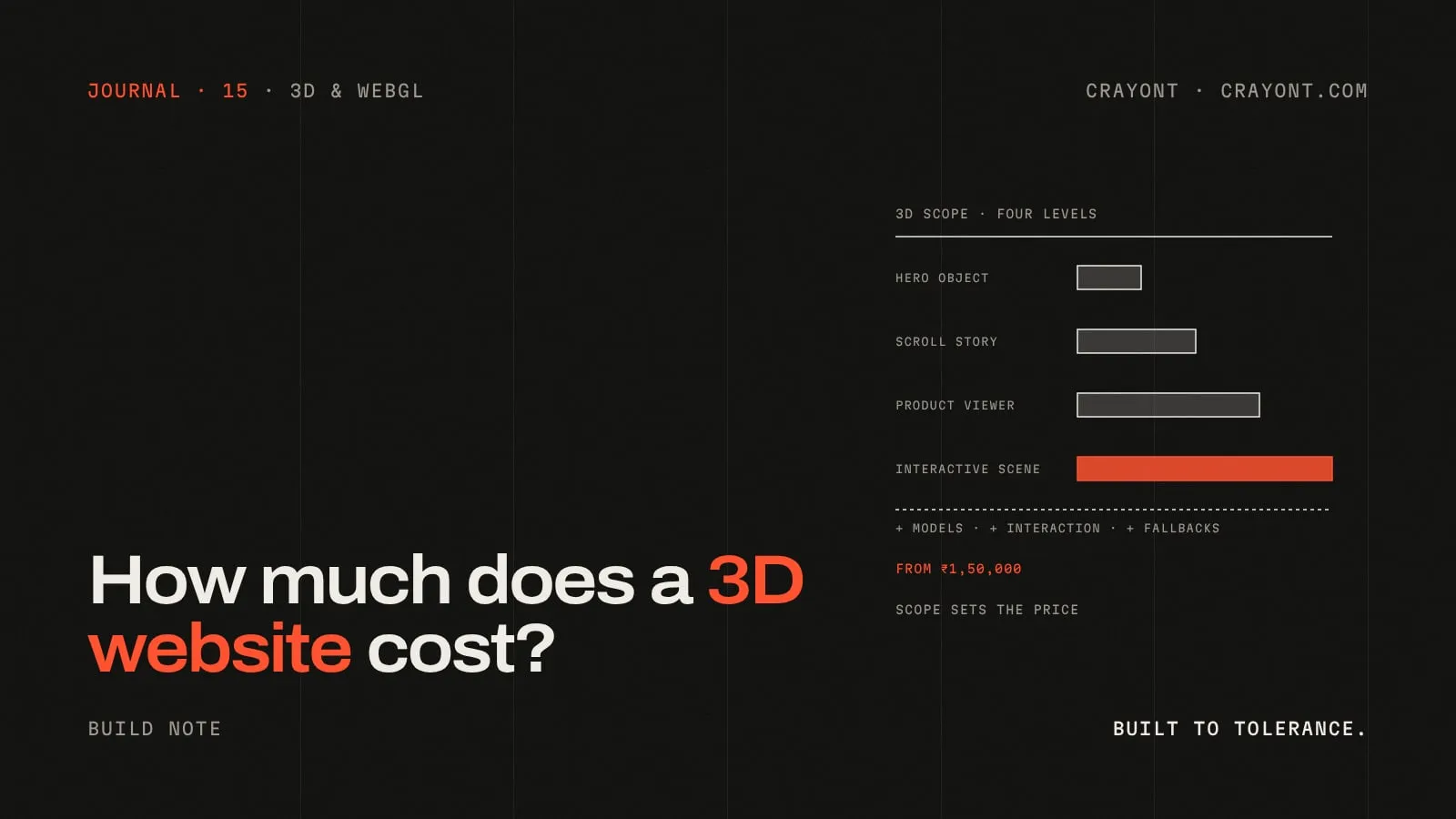
This is the biggest factor. Roughly four levels:
| Level | What it is | Typical use |
|---|---|---|
| Hero object | One 3D object or scene in the first screen that reacts to scroll or the cursor | A brand mark, a product, an abstract form |
| Scroll story | A scene that changes as the visitor scrolls through a section: parts assemble, a camera moves, a product turns | Explaining how something works |
| Product viewer | A model the visitor can turn, zoom and switch (colours, parts, options) | Products where shape and finish matter |
| Interactive scene | A space or world the visitor explores, with several objects and states | Launches, exhibitions, campaigns |
Each step up adds design time, build time and testing time. A hero object is a contained job; an interactive scene can take as long as the rest of the site put together.
2. Models and assets
Where the 3D content comes from often decides the budget more than the code does.
- Built in code. Abstract shapes, lines, particles, simple geometric parts. Cheap to make and very light to load.
- Reused models. CAD files from your engineers or models from a supplier. These usually need cleaning up and simplifying before they work on the web, but that’s cheaper than starting from nothing.
- Modelled from scratch. A detailed product, a building or a character made by a 3D artist. This is specialist work, priced separately, and it grows with detail and the number of objects.
- Animated models. Anything that moves on its own beyond turning (a character, a machine running) adds another layer of work.
If you’re getting quotes, ask each studio where the models come from and whether modelling is included. It’s the most common gap between two quotes that look similar.
3. Interaction
A scene that reacts to scroll is simpler than one the visitor controls. Each kind of interaction adds work: dragging to rotate, clicking parts, switching colours or materials, moving between views, connecting the scene to a cart or a form. The more states the scene can be in, the more there is to design and test.
4. Performance and fallbacks
This is the part cheap quotes leave out, and it’s the part that decides whether the site works.
A 3D scene that looks great on a designer’s laptop can take many seconds to appear on a mid-range phone on mobile data. Doing it properly means:
- Loading the page first and the 3D after, so visitors can read and act straight away.
- Skipping the 3D on devices and connections that can’t afford it.
- Pausing the scene when it’s off screen.
- A finished static version for slow phones, people who turn motion off, and search engines.
That static version isn’t a placeholder. It has to look designed, because for some of your visitors it is the site. We go through the technique in 3D websites that still load fast.
5. The rest of the site
A one-page launch site with a 3D hero is a smaller job than a 20-page company site that also has a product viewer. The page count, the CMS, languages, forms and integrations all add to the total in the same way they would on any website.
6. Looking after it
3D scenes depend on browsers and graphics drivers that keep changing. Plan for someone to check the site after major browser updates and fix anything that breaks. A care plan covers this; ours starts at ₹6,000 a month and includes monitoring and a monthly measured report.
What our 3D websites cost
Our 3D and WebGL websites start at ₹1,50,000. That starting price covers a site with one Three.js scene or scroll story, built so the page stays fast, with fallbacks for slower phones and reduced motion.
The price goes up with more scenes, models that need to be made, deeper interaction and more pages. For clients outside India we quote in USD, EUR or AED for the same scope.
We don’t quote from a call. We write a short spec first: what the scene shows, where it sits, what the visitor can do, where the models come from and the performance budget it has to meet. The price is fixed against that spec, so it doesn’t creep.
How to scope a 3D site without wasting money
Start from the job the 3D does. Write one sentence: “The 3D helps visitors understand ___.” If you can’t fill the blank, you probably need great photography, not WebGL.
Put 3D where it explains, not everywhere. One strong scene in the right place beats five weak ones. Visitors notice the first scene; they scroll past the fourth.
Use what you already have. CAD files, manufacturing files and supplier models can all cut modelling costs. Ask your engineering team before you commission new models.
Agree a performance budget up front. For example: the page is usable in under two seconds on a mid-range phone, and the 3D never blocks reading or tapping. Put it in the spec so it’s measured, not hoped for.
See it on a phone before you sign off. Ask for a live link during the build and open it on an ordinary Android phone on mobile data, not just a fast laptop. We share a live build link every week for this reason.
Questions to ask any 3D studio
- Are models included, and where do they come from?
- What happens on a slow phone, or when someone turns motion off?
- What does the page measure on a mid-range phone? Can you show a live site you’ve built and its numbers?
- Is the text real HTML that search engines can read, or is it inside the 3D canvas?
- What’s fixed in the price, and what counts as a change?
- Who looks after the scene after launch?
A studio that does this well will have clear answers. If the answer to question 2 is a blank screen or a loading spinner, keep looking.
Is it worth it?
For the right product or story, yes. A scene that shows how something is built, how parts fit, or what a space feels like can explain in seconds what paragraphs can’t. For a business that mainly needs enquiries, a fast, clear standard site usually does more per rupee, and you can add a 3D section later.
If you’re weighing it up, send us what you have in mind and we’ll tell you honestly whether 3D is worth it for your site, and what it would take. You can see what we’ve built on our work page. If you’re in Tamil Nadu or Karnataka, our pages for Chennai, Bengaluru and Vellore cover how we work with local clients.
Questions people ask
- How much does a 3D website cost in India?
- Our 3D and WebGL websites start at ₹1,50,000. That covers a site with one Three.js scene or scroll story and fallbacks for slower phones. The price grows with the number of scenes, the models you need and how much the visitor can interact with. We fix the price after a written spec, so the number you sign is the number you pay.
- Is a 3D website worth it for a small business?
- Only if the 3D explains something better than a photo or a video would: a product's shape, how parts fit together, a space someone hasn't visited. If it's decoration, a well-made normal site will usually do more for your enquiries for less money.
- Do I need to supply 3D models?
- Not always. Simple shapes, abstract forms and many product outlines can be built in code. If you already have CAD files or models from a manufacturer, they can often be cleaned up and reused, which is cheaper than modelling from scratch.
- Will a 3D website slow down my site?
- It doesn't have to. The page should load and be usable first, with the 3D loaded afterwards and only on devices that can handle it. We wrote up how we do that in our guide to 3D websites that load fast.
- How long does a 3D website take?
- Longer than a standard site, because the scene needs its own design, build and testing on real phones. The timeline depends on the scope and on whether models need to be made, and it's written into the spec before work starts.
Keep reading
All notes →- 3D and WebGL websites that still load in under two secondsHow we build 3D and WebGL websites that stay fast on a mid-range phone: poster first, GPU gating, on-demand rendering and a designed reduced-motion state.
- Redesign or fix? How to tell if your website needs a redesign, and what one costsNot every tired website needs a redesign. A simple test for redesign vs fix, the signs that mean start again, what a redesign costs and how to do one without losing rankings.
- How much does a website cost in India in 2026?What a website costs in India in 2026, from DIY builders to studios, what moves the price, the hidden yearly costs, and how to compare quotes fairly.