Hiring a web design agency in India from the UK or the Gulf: what to check first
A practical checklist for UK and Gulf businesses hiring an Indian web design studio in 2026: time zones, contracts, payments, ownership, quality checks and red flags.

- Published
- Reading time
- 6 min
TL;DR · Key takeaways
- The price gap is real, but it is not the reason to hire in India. Hire a studio because its work, process and written spec are good; the lower rate is a bonus, not the plan.
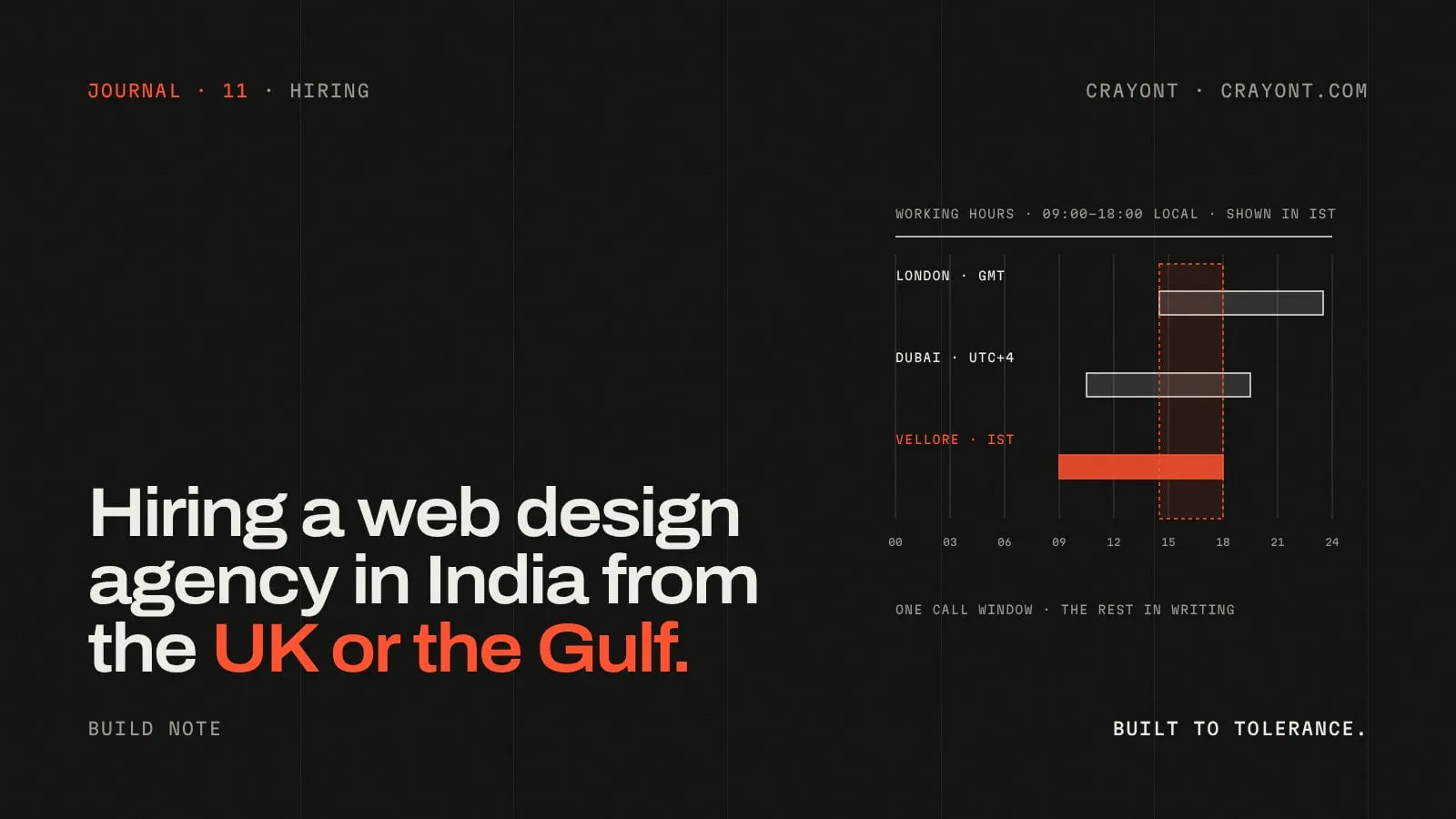
- Time zones work in your favour if you plan for them. India is 1.5 hours ahead of the UAE and 4.5 to 5.5 hours ahead of the UK, so a daily overlap of three to six working hours is normal.
- Insist on four things in writing: a fixed-price spec, a payment schedule tied to milestones, a weekly live build link, and full ownership of code, domain and accounts at handover.
- Check quality yourself before you sign: open their live sites on your phone, run one through PageSpeed Insights and ask who exactly will build yours.
If you run a business in London, Manchester, Dubai or Doha, you’ve probably had the cold email: a web design company in India offering a full website for a fraction of a local quote. Some of those studios are excellent. Some will hand you a template, a broken contact form and silence. The country doesn’t decide which one you get. How you choose and how you contract does.
This is the checklist we’d want a client to run on us. It’s written from the studio side, so it’s honest about where offshore projects go wrong.
Start with the right reason
The rate difference is real. A UK agency day rate and an Indian studio day rate are not close, and that gap is why most people look.
But price alone is a weak reason to hire anyone. If the only thing a studio offers is “cheaper”, you’ll pay for it later in rework, slow pages or a site you can’t edit. Hire because:
- their live work is good and fast on a phone;
- their process gives you a written spec before any money moves;
- you can talk to the people who will actually build your site.
If a studio clears those three, the lower rate is a bonus. If it doesn’t, the rate doesn’t matter.
Time zones: plan the overlap
India runs on IST (UTC+5:30) all year, with no daylight saving.
- UAE (UTC+4): India is 1.5 hours ahead. Working days overlap almost entirely.
- Qatar, Saudi Arabia, Kuwait, Bahrain (UTC+3): India is 2.5 hours ahead. Plenty of overlap.
- UK: India is 5.5 hours ahead in winter (GMT) and 4.5 hours ahead in summer (BST). A UK morning meets an Indian afternoon, so you share about three to four working hours.
Two habits make this painless:
- Fix one call window a week inside the overlap, and keep it. Everything else happens in writing.
- Use the gap. Send feedback at the end of your day; it can be worked on before you’re back at your desk.
What doesn’t work is expecting instant replies at 6pm London time. Agree response times in the contract instead.
The four things to get in writing
1. A fixed-price spec
Before you pay anything beyond a small deposit, you should have a written specification: pages and templates, features, integrations, what content you provide, browsers and devices tested, and performance targets. The price is fixed against that document. Anything outside it is a change request with its own price, agreed before the work.
This protects both sides. Most offshore projects that go wrong skipped this step.
2. A payment schedule tied to milestones
Avoid paying 100% upfront. A common, fair split is a deposit to start, a payment when the design is approved, and the balance at launch. Agree the currency, how exchange rates are handled and who pays transfer fees before the first invoice. Wise, PayPal and ordinary bank transfers are all normal.
3. A weekly live build link
You should be able to open a real, working version of your site every week, not screenshots or a PDF. A live link shows you actual progress, catches misunderstandings early and makes “it’s nearly done” impossible to fake.
4. Full ownership at handover
Agree up front that you own:
- the domain, registered in your name from day one;
- the hosting and CMS accounts, in your name or transferred at launch;
- the code, in a repository you control;
- any fonts, images and plugin licences, bought in your name or clearly listed.
If a studio wants to keep the domain or hosting “for convenience”, say no politely.
How to check quality before you sign
You don’t need to be technical to check a studio’s work. Spend twenty minutes on this:
- Open three of their live client sites on your phone, on mobile data, not office Wi-Fi. Do they load quickly? Can you tap everything easily? Does the contact form work?
- Run one through PageSpeed Insights. Look at the mobile result and the Core Web Vitals section. You’re looking for green, not perfection. (Our Core Web Vitals checklist explains what the numbers mean.)
- Check the details. Typos, a footer with an old copyright year, links to a template’s demo page. If a studio’s own client sites have these, yours probably will too.
- Ask who will build your site. Names, not “our team”. With a small studio, you should be able to speak to them.
- Ask for a reference you can actually contact. A client who will answer an email is worth more than any logo wall.
Questions for the first call
Keep the first call short and ask these. The answers tell you more than the slide deck:
- “What would you need from us before you can write a spec?”
- “What’s not included in a typical quote?”
- “How do you handle a change halfway through?”
- “What happens to our existing URLs and rankings?”
- “Who fixes things after launch, and for how long?”
- “Which of your live sites would you show us first, and why?”
A studio that answers with specifics, and asks you good questions back, is usually one that plans its work. Vague answers now become vague invoices later.
Red flags
- A full quote within an hour of your first message, with no questions asked.
- No written spec, or a spec that’s a list of page names.
- A demand for full payment upfront.
- The studio registers your domain in its own name.
- Every portfolio site uses the same theme with different colours.
- Promises of “first page of Google in 30 days”. Nobody can promise rankings.
- Reviews that read like copies of each other.
One red flag can be a misunderstanding. Two is a pattern.
What it costs
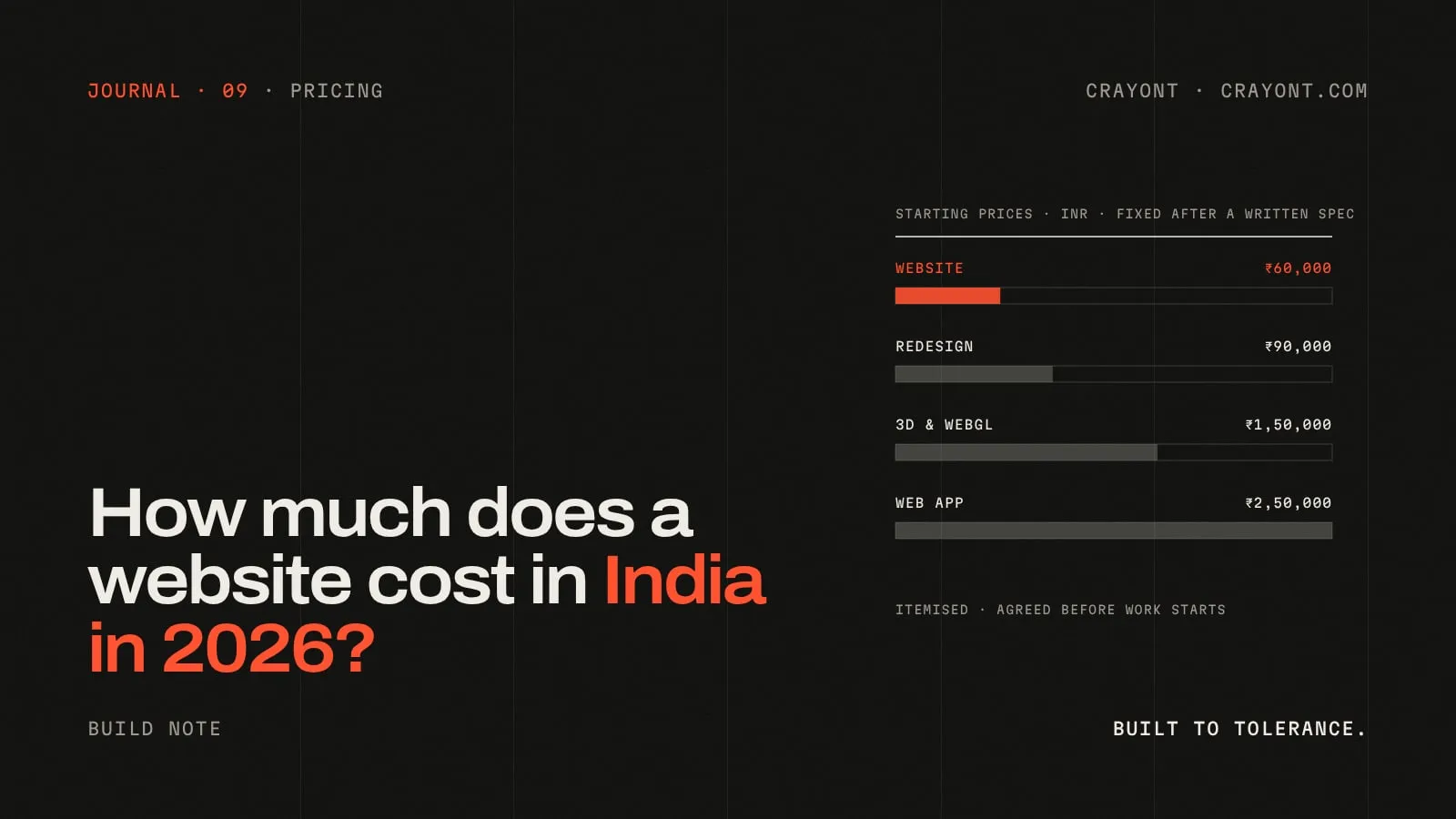
Indian studio prices vary widely with scope. As one reference point, these are our published starting prices in INR. International projects are quoted in USD, EUR or AED for the same scope:
| Service | From |
|---|---|
| Website design & development | ₹60,000 |
| Website redesign with SEO migration | ₹90,000 |
| 3D & WebGL website | ₹1,50,000 |
| Web app or platform | ₹2,50,000 |
| Core Web Vitals audit | ₹15,000 |
The full breakdown of what moves a price is in how much a website costs in India. If you’re replacing a site that already ranks, read our redirect-map checklist before you sign with anyone; a redesign without one can cost you years of search traffic.
For agencies: white-label work
Some of the UK and Gulf businesses reading this are agencies themselves: design or branding studios that sell websites but don’t have developers. The same checklist applies, plus two extras:
- Agree confidentiality in writing. You keep the client relationship; the build partner never contacts them.
- Start with one small project. A landing page or a single template tells you more about a partner than any call.
How we work, briefly
We’re Crayont, a two-founder design-engineering studio in Vellore, India. Every project starts with a written spec and a fixed price. You get a live build link every week, and you own everything at launch. You can see our work and services, and if you’d like a spec for your project, tell us what you need.
Whoever you hire, run the checklist. A good studio will be glad you did.
Questions people ask
- Is it safe to hire a web design company in India?
- It is as safe as the studio you pick and the contract you sign. Pay in milestones rather than all upfront, keep the domain and hosting in your own name from day one, and ask for a live build link you can watch every week. Those three habits remove most of the risk, wherever the studio is.
- How do I pay an Indian studio from the UK or the UAE?
- Usually by international bank transfer or a payment platform such as Wise or PayPal, against an invoice in your currency. Agree the currency, the exchange-rate handling and who pays transfer fees before the first invoice.
- Will the time difference slow the project down?
- Not if the work is set up for it. With a written spec, a weekly live link and one agreed overlap window for calls, the difference often helps: feedback you send in the evening can be worked on before your next morning.
- Does Crayont work with clients in the UK and the Gulf?
- Yes. We are a two-founder studio in Vellore and work with clients in India and abroad. International projects are quoted in USD, EUR or AED, fixed after a written spec, with the same weekly live build link every client gets.
Keep reading
All notes →- Website development in Chennai: what a custom-built site should include, and a brief you can copyHiring a website development company in Chennai? What a custom-coded site should include, what it costs, the questions that matter and a one-page brief you can copy.
- How much does a website cost in India in 2026?What a website costs in India in 2026, from DIY builders to studios, what moves the price, the hidden yearly costs, and how to compare quotes fairly.
- Choosing a web design agency in Vellore or Bangalore: nine questions that separate a studio from a resellerLooking for a web design agency in Bengaluru, Chennai or Vellore? Nine questions to ask before you sign, and what the answers tell you.