Bengaluru7 min read
Web design in Bengaluru: how to judge a website design before you pay for the build
Hiring a web design company in Bengaluru? How to read a portfolio, what a design review should check, what web design costs and a brief you can copy.

Quick summary
- Most search results for 'web design company in Bengaluru' are directories. A directory listing tells you a company exists, not whether its designs work.
- Judge a portfolio by opening live sites on your own phone, not by looking at screenshots or Dribbble shots.
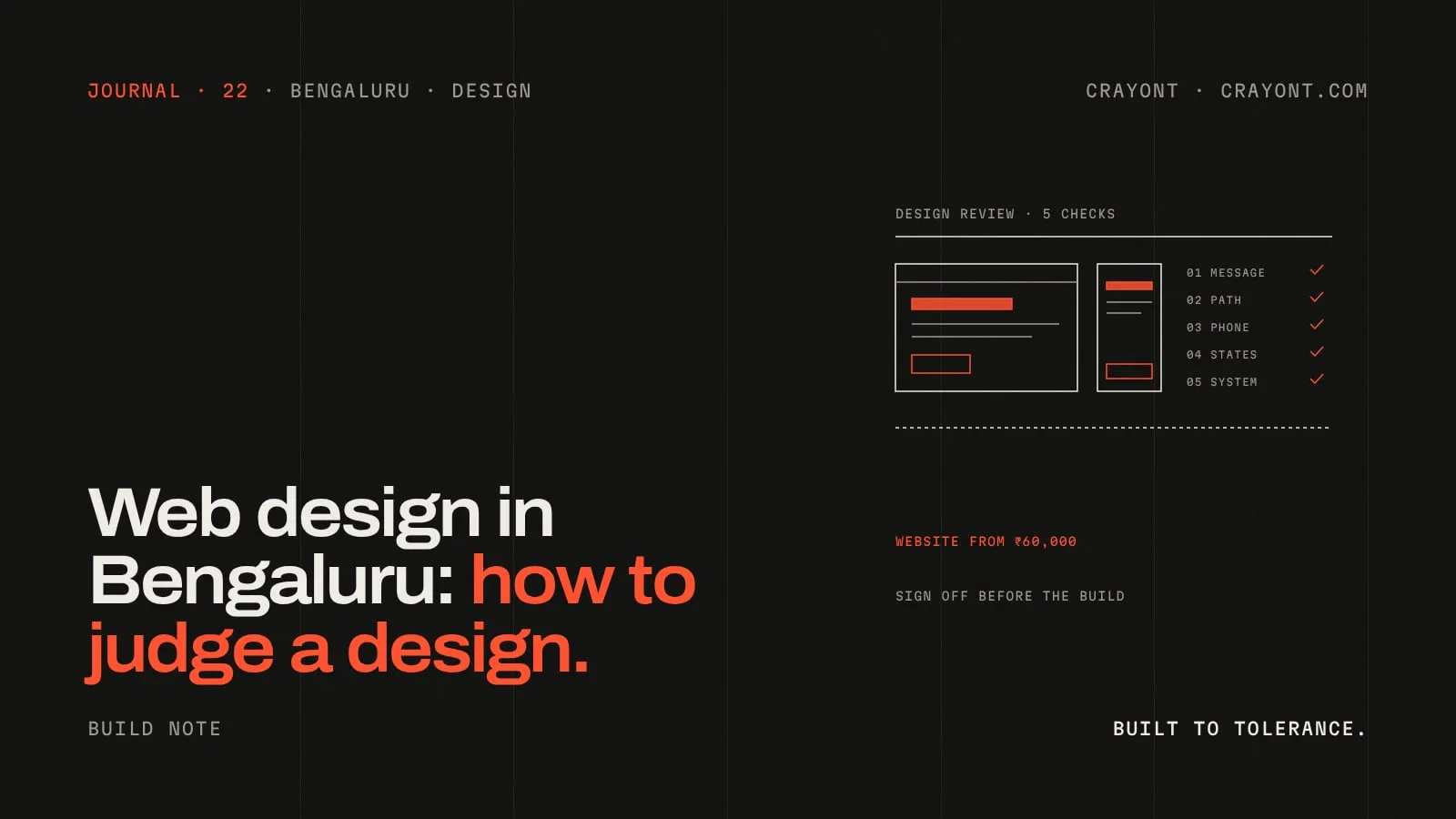
- A design review should check five things: the message, the path to an enquiry, the phone layout, the states (errors, empty, loading) and the system behind the pages.
- Sign off the design before the build starts, and get it in writing. Changes after the build starts cost more.
- Our websites start at ₹60,000 and redesigns at ₹90,000, fixed against a written spec.
Search for a web design company in Bengaluru and the first page is mostly directories and ranking lists, plus a few agency pages that all promise “stunning, responsive, SEO-friendly” design. That tells you very little. Almost every company says the same words, and a directory rank usually reflects reviews and paid placement, not the quality of the work.
So this guide skips the “top 10” format. It covers how to judge a website design yourself: how to read a portfolio, what to check in a design review, what web design costs and a brief you can send to any studio in Bengaluru, including us.
What web design is actually for
A website design is good when the right visitor understands what you do, trusts you and takes the next step, quickly, on the device they’re holding. Looks matter, but only in service of that.
For most Bengaluru businesses the next step is one of these:
- A SaaS or startup: book a demo, start a trial or join a waitlist.
- A D2C brand: buy, or at least add to cart.
- A services firm or consultancy: send an enquiry or book a call.
- A clinic, school or local business: call, send a WhatsApp message or book a slot.
Write down which one applies to you before you look at a single design. Every page should be judged against it.
How to read a portfolio
A portfolio is the best evidence you’ll get, but only if you read it properly.
- Open live sites, not screenshots. Ask for links. Open them on your own phone, on mobile data. A shot on a design gallery says nothing about how the site loads or scrolls.
- Look past the homepage. Open an inner page: a service page, a product page, a blog post, the contact page. Weak designers polish the homepage and leave the rest as a template.
- Try the enquiry. Fill in the form with a wrong email and see what happens. Tap the phone number. Tap the WhatsApp button. Those are the parts that bring in business.
- Check that the sites differ. If every site in the portfolio looks the same, you’ll get that look too, whatever your brand is.
- Ask what the designer did. Strategy, design, build, content? Who wrote the copy? A portfolio piece where the agency only did the visuals on someone else’s plan is a different kind of proof.
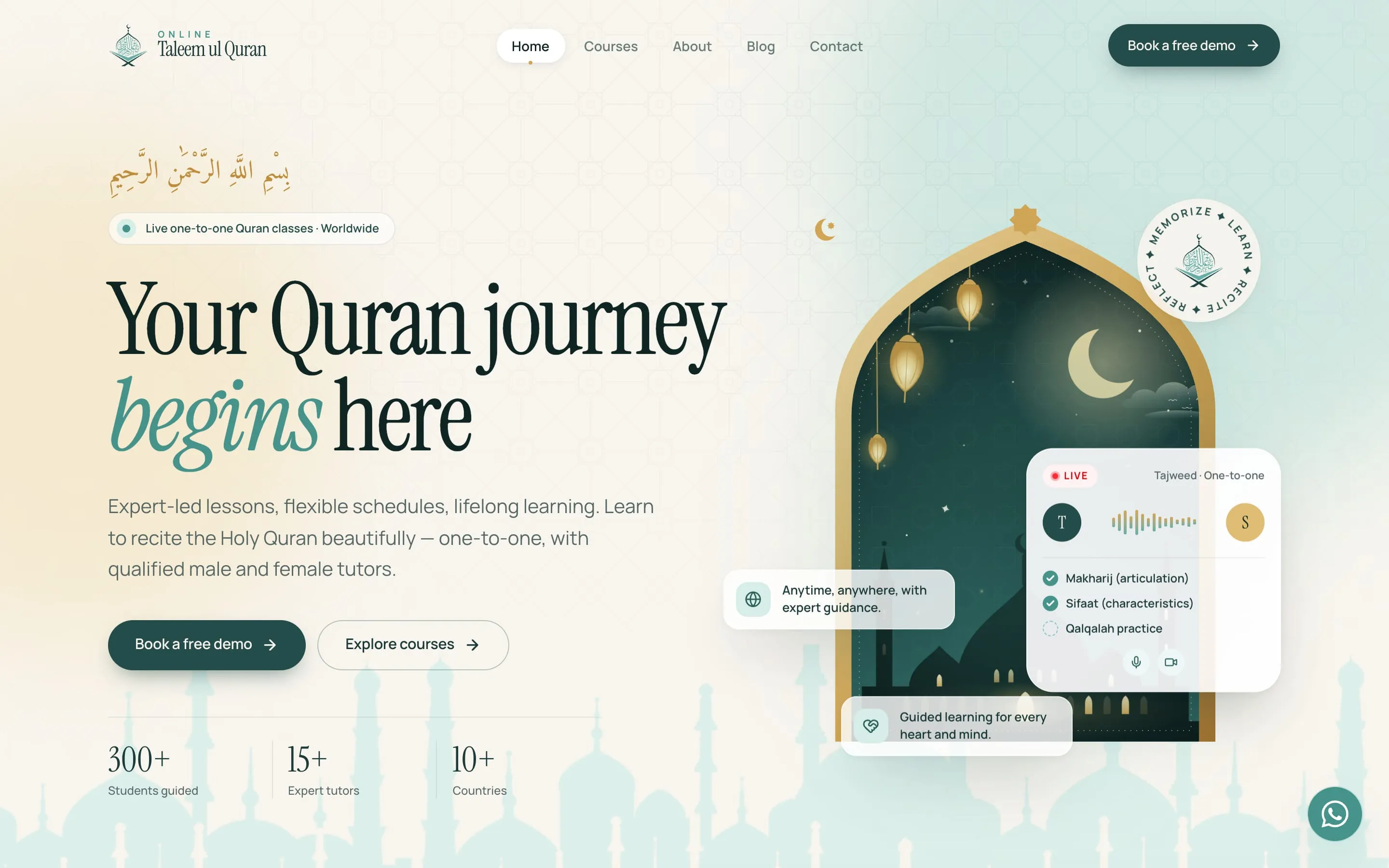
Our own work page lists what we did on each project. For example, on the Online Taleem ul Quran redesign we made a new design system and original illustrations, and gave the site a clear path to a free demo class.
The five checks in a design review
When a company sends you a design, don’t start with “do I like the colours?”. Go through these five checks in order.
1. The message
Read the first screen as a stranger would. Can you say, in one sentence, what the business does and who it’s for? Is there one clear action? A headline that could belong to any company (“Innovating your digital future”) fails this check, however good it looks.
2. The path to an enquiry
Count the taps from the homepage to a sent enquiry. It should be two or three. Check that every important page has a way forward, not a dead end. Pricing, proof (case studies, reviews) and the contact action should be easy to find, not hidden in the footer.
3. The phone layout
Most Bengaluru visitors will see the site on a phone first. Ask to see the phone design for every key page, not only desktop. Check that text is readable without zooming, that buttons are large enough to tap, and that nothing important sits below a long block of decoration.
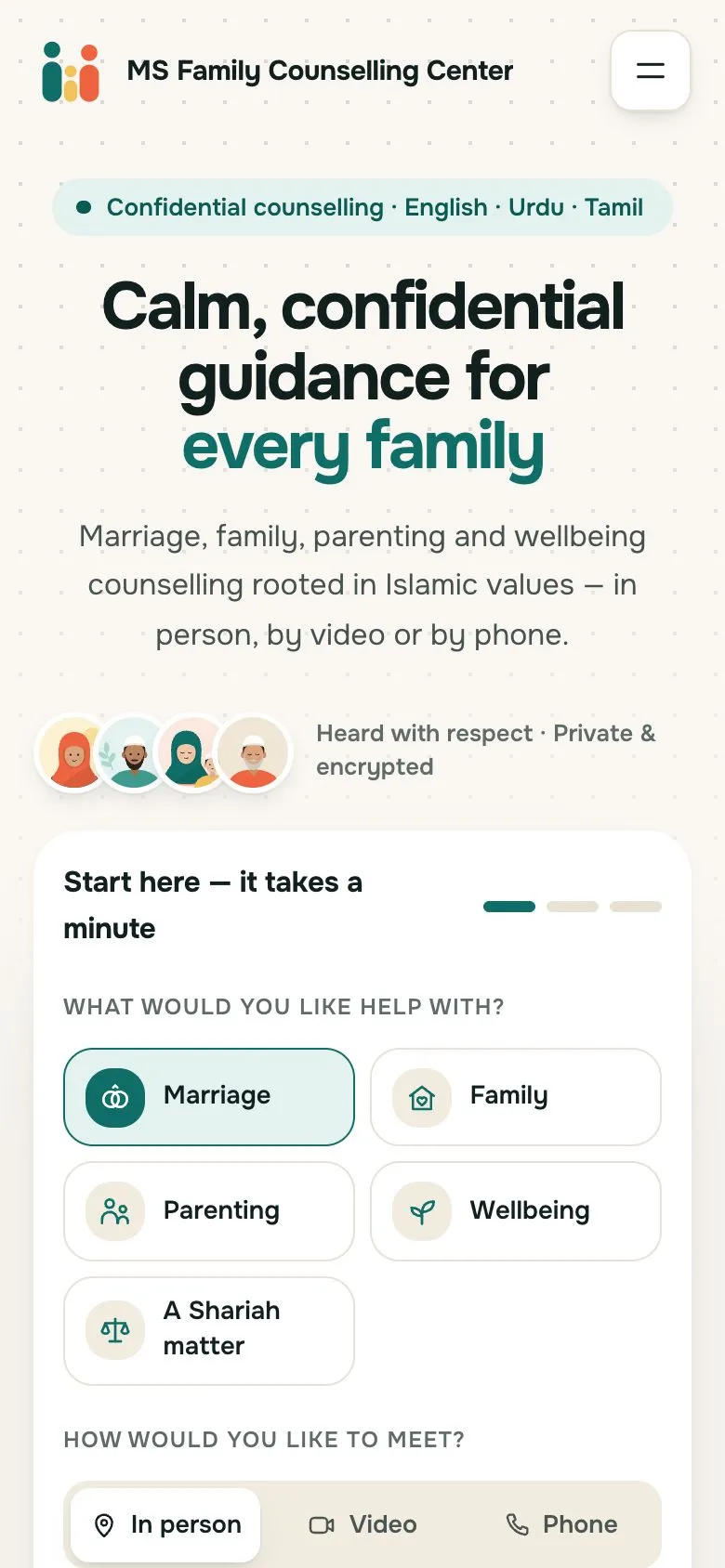
Home
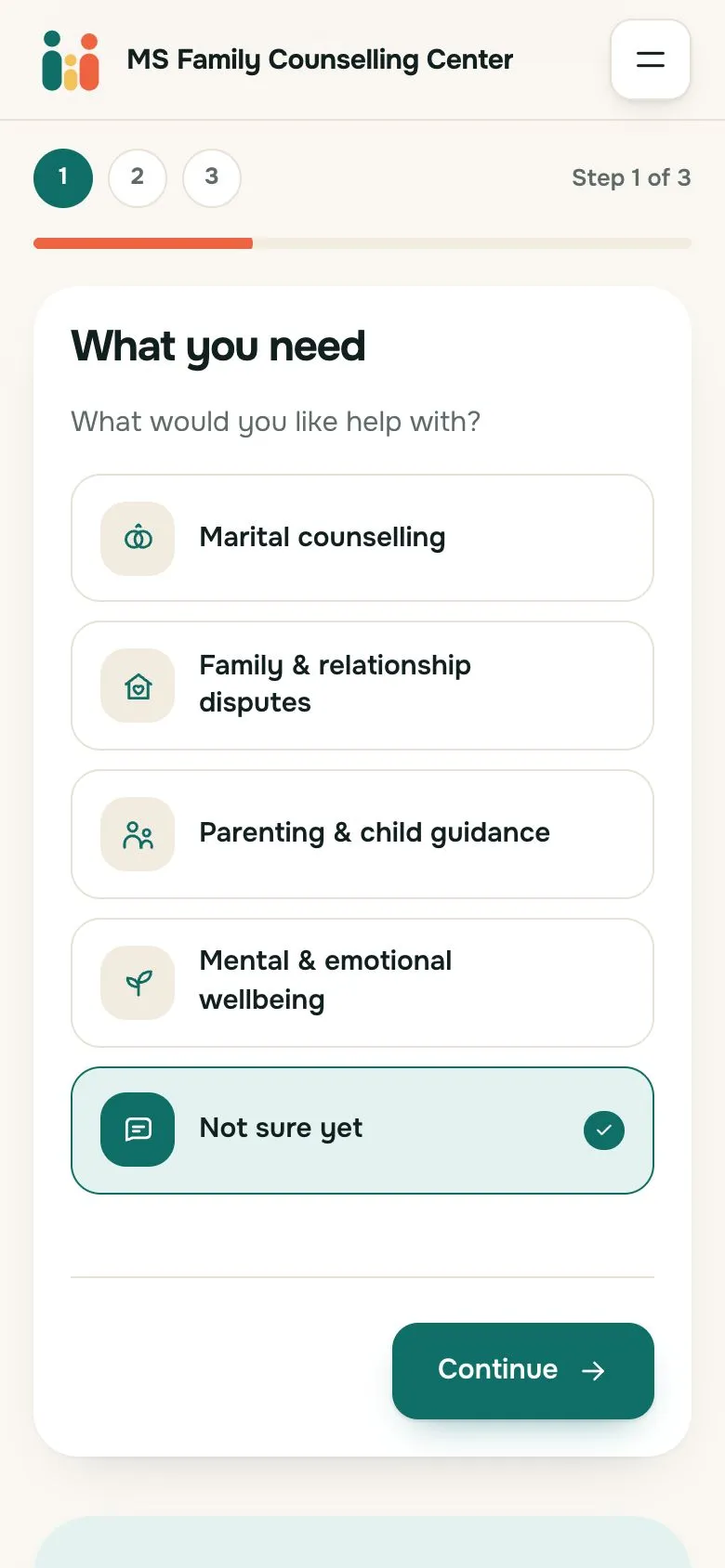
Booking
4. The states
Good design covers what happens when things go wrong or are empty:
- A form with an error, and the message after it’s sent.
- A page with no results, or a blog with only two posts.
- Long names, long product titles and a Kannada or Hindi heading if you’ll use one.
- A slow connection: what the visitor sees before the images load.
If the design only shows the perfect case, the developer will make these up later, and it usually shows.
5. The system
A website isn’t a set of separate pictures. It’s a system of type sizes, colours, spacing, buttons and section layouts that your team will reuse for years. Ask to see it on one page. A design built on a clear system is cheaper to build, faster to load and easier to grow. A design where every page is a one-off will cost you every time you add a page.
Design and speed are the same decision
Big hero videos, five font files and heavy animation look good in a presentation and slow the site on a real phone. Google measures that speed with Core Web Vitals, and visitors leave slow sites before they see anything.
So ask the designer how the design will load, not just how it looks. Agree speed targets in writing, measured on a mid-range phone. Our Core Web Vitals checklist lists the three numbers and the limits worth agreeing. When we design, we plan the image sizes, fonts and motion with the build in mind, because the same people build it.
Sign off before the build
The cheapest time to change a design is before anyone writes code. Agree it like this:
- Review on a link, on your own laptop and phone, not as a PDF.
- Collect feedback in one place, from everyone who has a say, in one round, so the designer isn’t chasing five opinions.
- Sign off in writing once the design passes the five checks.
- Treat later changes as changes, with a clear note of what they add to time and cost.
A good company tells you how many review rounds are included before you sign, and doesn’t make you feel bad for using them.
What web design costs
Location doesn’t set the price. Scope does. Our starting prices:
| What you need | Starting price |
|---|---|
| Starter business site (clinics, shops, local firms) | ₹12,999 |
| Website (up to 8 pages, CMS, SEO set-up) | ₹60,000 |
| Website redesign (with a full redirect map) | ₹90,000 |
| 3D and WebGL website | ₹1,50,000 |
| Web app or portal | ₹2,50,000 |
What moves the price above the starting point:
- Number of unique page layouts. Ten pages that share three layouts cost less than ten pages that are all different.
- Content. Whether we write and source it, or you do.
- Illustration, photography or 3D. Original artwork takes time; we’ll say who makes it.
- Features. Bookings, payments, logins, a CRM connection or several languages.
You’ll see much lower prices in Bengaluru, often a template with a new logo. That can be fine for a one-page site you need this week. It gets expensive when you need to rank, take enquiries or grow the site. We go through the full range in how much a website costs in India.
The cheapest time to change a design is before anyone writes code.
If you already have a site
A redesign that changes your page addresses without a redirect map can lose your Google rankings. Before you talk about colours, ask how the company will carry your rankings over. Our redirect-map checklist explains how, and redesign or fix? helps you decide whether you need a new design at all.
Questions to ask any web design company in Bengaluru
Ask before you sign
- Can I open three live sites you designed, on my phone, right now?
- Who designs, and who builds? Can I talk to them directly?
- Will you show the phone design for every key page?
- How many review rounds are included, and how do we give feedback?
- Will the design include error, empty and loading states?
- What speed will the finished site hit on a mid-range phone, in writing?
- Who owns the design files, code, domain and hosting at the end?
- What happens if something breaks after launch?
The longer version is our nine questions that separate a studio from a reseller.
A one-page brief you can copy
Company: [name, what you do, who your customers are]
Main action on the site: [demo / buy / enquiry / call or WhatsApp / booking]
Pages: [home, services or products, about, pricing, contact, others]
Sites you like, and why: [2–3 links]
Sites you don't want to look like: [1–2 links]
Brand assets: [logo, colours, fonts, photos, none yet]
Content: [we have it / we need help writing it]
Languages: [English / Kannada / Hindi / others]
Who will edit the site: [names or roles]
Current site (if any): [URL, and what's wrong with it]
Speed target: [e.g. usable in under 2 seconds on a mid-range phone]
Budget band: [range]
Launch date: [and why that date]
How we work with Bengaluru companies
We’re Crayont, a two-founder design-engineering studio in Vellore. I (Riyaz) design and build the front end. Salman builds the back end, forms, payments and integrations. Because the same two people design and build, the design you sign off is the site you get.
Work with Bengaluru teams is remote: a call to start, a written spec with pages, features, timeline, price and speed target, then a preview link you can open on your own phone every week and a short written update every Friday. The steps are on our process page.
Suggested readWebsite development for Bengaluru startups: what to build first, and what it costsSee our web design page for Bengaluru, the full website design and development service, or what we’ve built on the work page. When you have a brief, even a rough one, send it to us. You’ll get an honest yes, no or “start smaller” within a working day.
Questions people ask
- How much does web design cost in Bengaluru?
- Our websites start at ₹60,000 for up to 8 pages with a CMS and SEO set-up, and redesigns start at ₹90,000 with a full redirect map. Small starter sites for clinics, shops and tuition centres start at ₹12,999. The final price is fixed after a written spec.
- Is web design separate from web development?
- It can be, but it works better together. When the people who design the pages also build them, the design is planned for real content, real phones and real speed targets, not just for a pretty mock-up.
- How many design revisions do we get?
- Ask every company this before you sign. We agree the number of review rounds in the written spec, and every round is reviewed on a link you can open on your own phone.
- Do we own the design files?
- You should. With us, the design files, the code, the domain and the hosting are in your name at the end of the project.
- Do you work with Bengaluru companies?
- Yes. We're based in Vellore, a few hours from Bengaluru, and work with Bengaluru teams remotely: a kick-off call, a written spec, a preview link every week and a written update every Friday. A meeting in Bengaluru can be arranged.
Keep reading
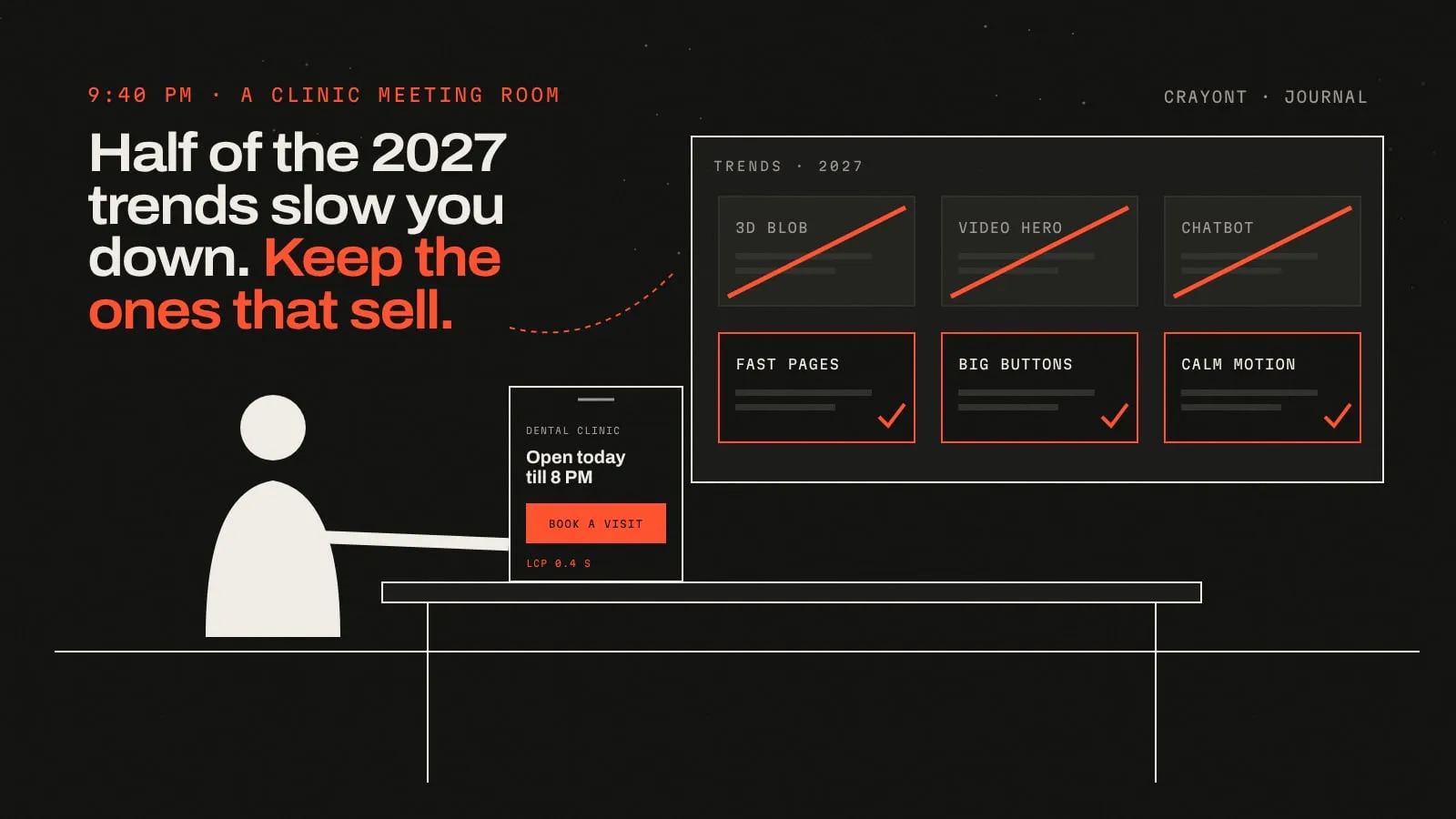
All notes →- Web design trends for 2027 that actually help a business websiteSix web design trends worth using in 2027, checked against browser support data and Google's own thresholds, plus the ones to skip and a brief you can hand to any designer.
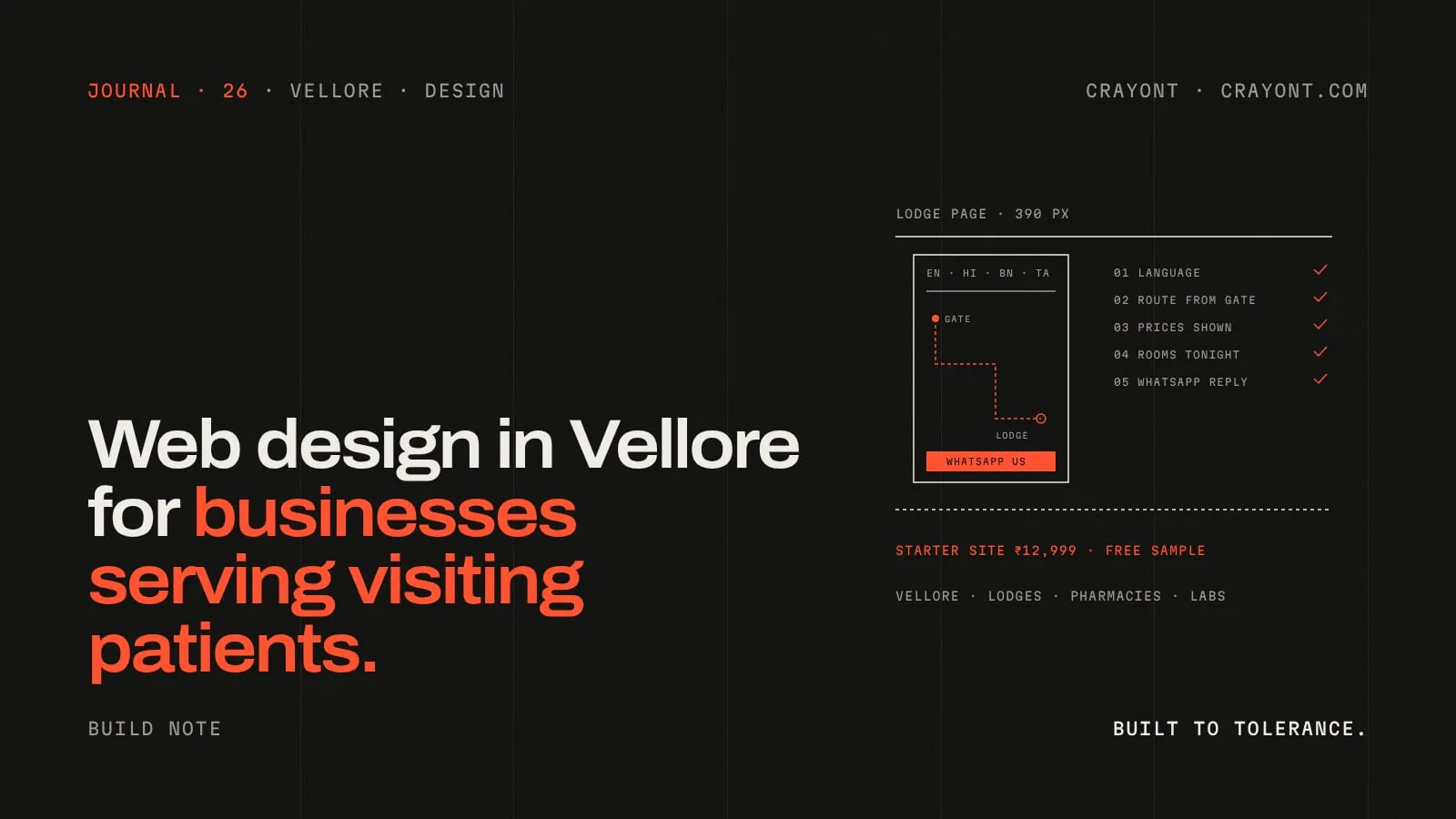
- Web design in Vellore for lodges, pharmacies and services that look after visiting patientsNeed a website for a lodge, pharmacy, lab or service that families visiting Vellore's hospitals rely on? How to design it for people far from home: languages, maps, prices, WhatsApp, what it costs and a brief you can copy.
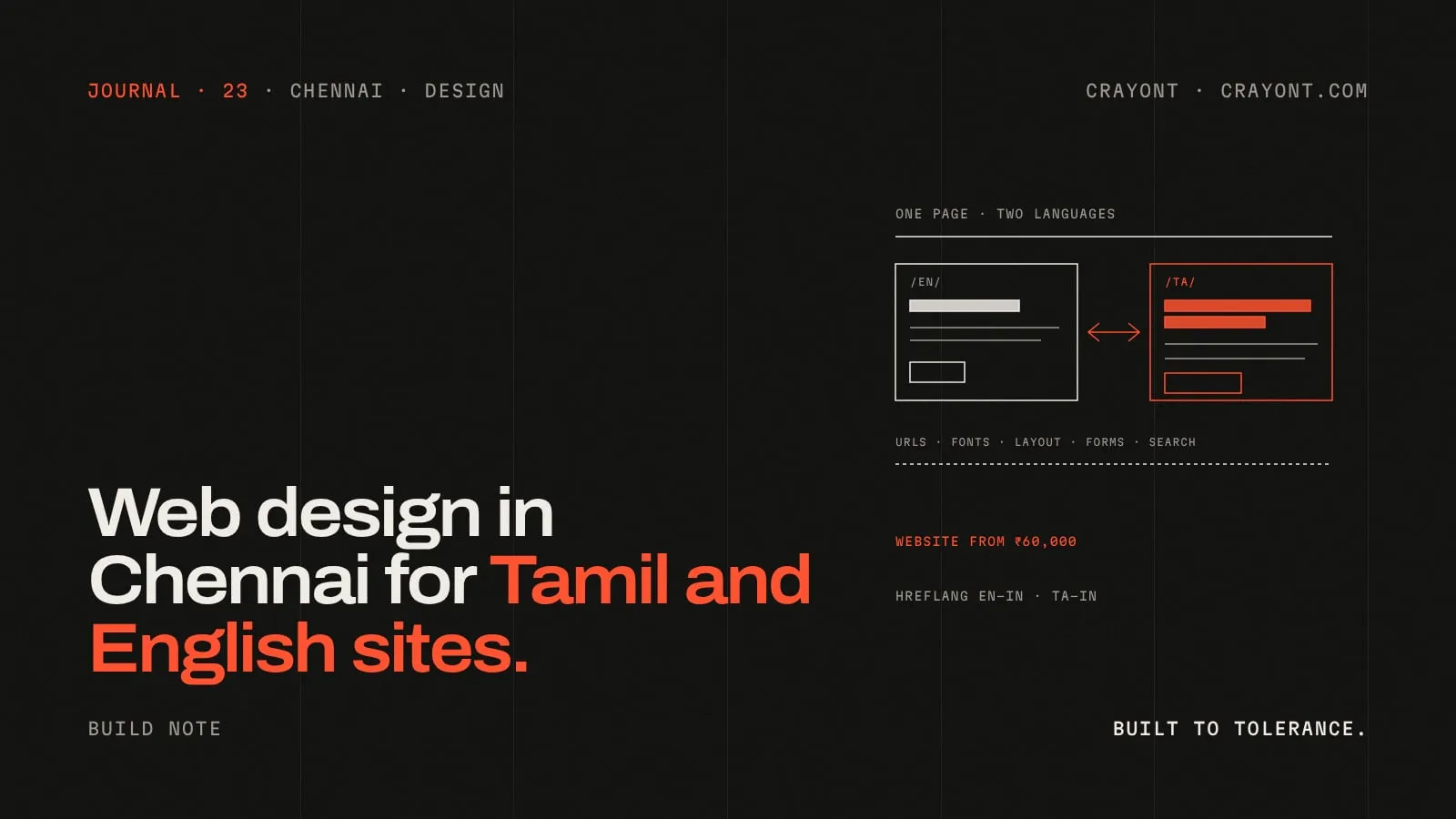
- Web design in Chennai: how to design a website in Tamil and EnglishNeed a website in Tamil and English for your Chennai business? How to plan the languages, fonts, layout, forms and SEO, what it costs and a brief you can copy.