Chennai8 min read
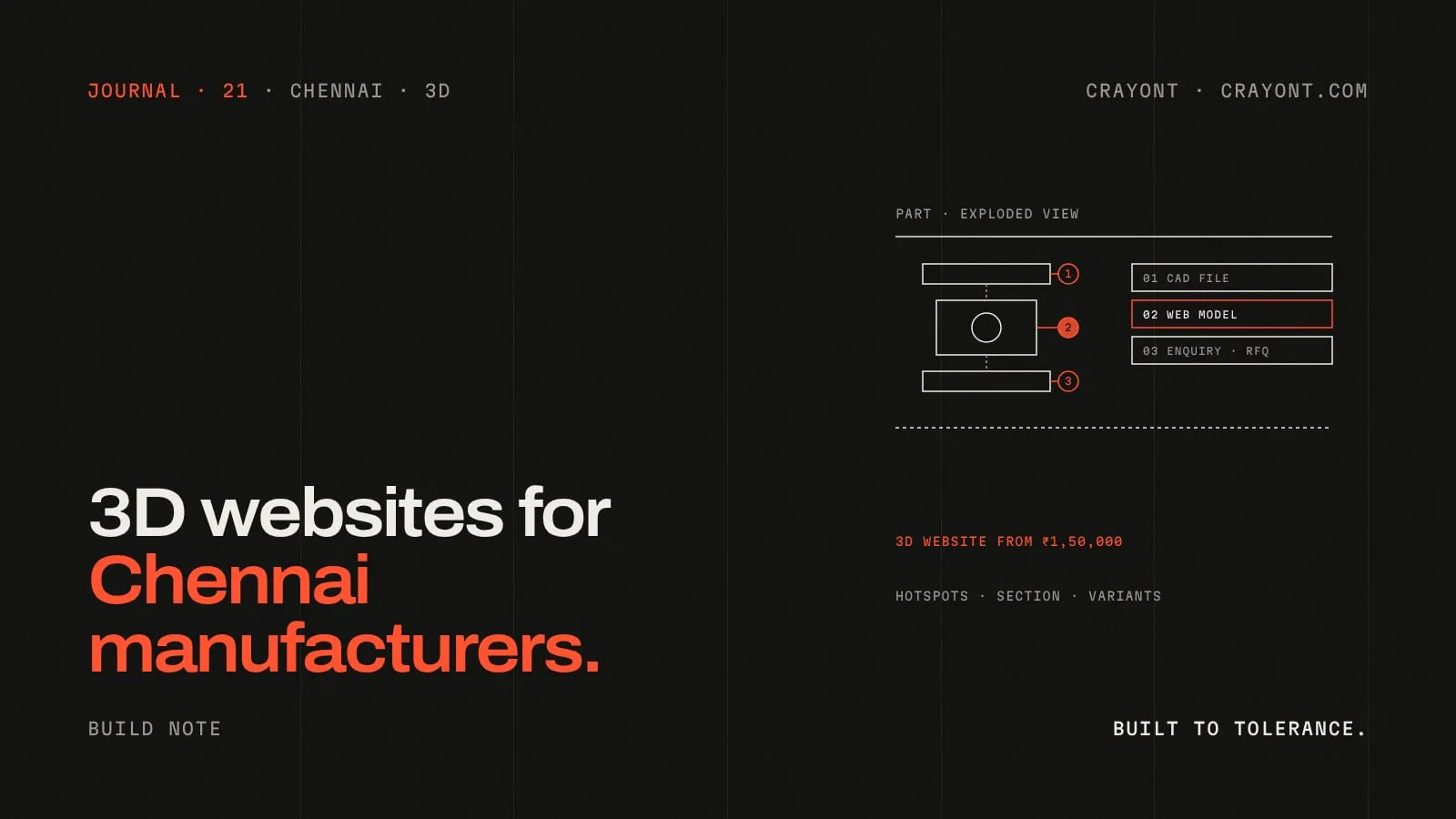
3D websites for Chennai manufacturers: showing industrial products in 3D, from CAD file to enquiry
Looking for 3D or WebGL website development in Chennai? How manufacturers can show parts, machines and assemblies in 3D on their website, what it takes, what it costs and a brief you can copy.

Quick summary
- For manufacturers, 3D earns its place when a buyer has to understand a part's shape, fit or inside before they ask for a quote. A brochure PDF and four photos rarely do that.
- You probably already have the hardest part: the CAD model. It needs to be simplified for the web, with anything confidential removed.
- The most useful 3D views for industrial products are an exploded view, labelled hotspots and a cross-section, not a spinning logo.
- Every 3D view should end in a real enquiry: a request-for-quote form that carries the part number and the options the buyer looked at.
- Our 3D and WebGL websites start at ₹1,50,000, fixed against a written spec.
Search for 3D website development in Chennai and the results are mostly freelance gig listings and agency pages that promise “immersive experiences”. Neither helps a manufacturer decide whether putting a pump, a gearbox, a die-cast housing or a control panel into 3D on their website would bring in better enquiries.
This guide is for Chennai manufacturers, the auto-component suppliers, machine builders, electrical and electronics makers along the city’s industrial belts, who sell to buyers who need to understand a part before they ask for a price. It covers when 3D is worth it, which views help, how a CAD file becomes a web model, what it costs and a brief you can send to any studio, including us.
When 3D is worth it for industrial products
Most manufacturer websites show a product with a few photos, a spec table and a PDF brochure. That works when the buyer already knows the part. It struggles when they need to see:
- How it fits. Mounting points, flange patterns, connector positions, clearances.
- What’s inside. The internals of a valve, a motor or a gearbox, which a photo can’t show.
- How it’s built. An assembly that a buyer’s engineer wants to understand before recommending you.
- Variants. Sizes, mounting options or materials that would otherwise need a photo of each.
If the buyer is an engineer or a purchase team comparing suppliers, being able to turn the part, open it up and read the labels is a real advantage. It answers questions that would otherwise take an email, a call and a wait.
3D is usually not worth it when the product is a commodity bought on price and spec alone, when the range is hundreds of near-identical items, or when buyers never visit the website before calling. In those cases a clean spec table, a fast site and a good quote form do more.
If you’re unsure, start with one hero product, the one your sales team explains most often, and see whether visitors use it.
The views that help buyers
A spinning model on a homepage looks nice and tells the buyer very little. These are the views that do work:
Do
An exploded view, labelled hotspots and a cross-section.
The buyer sees how the part is built, what each feature is and what's inside.
Don't
A spinning model on the homepage.
It looks nice and tells the buyer very little.
Exploded view
The assembly separates into its parts as the buyer scrolls or presses a button, then comes back together. It shows how the product is built far better than a drawing, and it’s the view sales teams end up using in meetings.
Hotspots
Numbered points on the model that open a short label: material, tolerance, part number, a note on what the feature does. They turn the spec table into something the buyer reads while looking at the part.
Cross-section
A clipping plane cuts through the model so the buyer can see inside: the flow path in a valve, the windings in a motor, the bearing arrangement in a gearbox. It’s often the single most persuasive view for an engineering buyer.
Variants
Swap between sizes, mounting options or finishes on the same model. This is the same idea as a product configurator, but for industrial products the aim is usually to help the buyer pick the right variant before they ask for a quote, not to sell from a cart.
Scroll story
For a launch or a flagship machine, the page tells the story as the buyer scrolls: the outside, then the inside, then the key features, each with real text beside it. It suits a homepage or a trade-show landing page.
From CAD file to web model
You probably already have the hardest part. Your engineering team’s CAD model is accurate, but it’s built for manufacturing, not a browser. Getting it onto a web page takes a few steps:
- Export. Your team exports the assembly (STEP or a similar neutral format usually works).
- Strip what shouldn’t be public. Internal geometry, exact dimensions and anything under NDA are removed or simplified. You approve what stays.
- Reduce. Engineering models can carry far more detail than a screen needs. We rebuild or decimate the geometry to a few megabytes while keeping the visible shape accurate.
- Split into parts. Each part that moves in an exploded view or changes between variants is kept separate.
- Materials. Steel, cast aluminium, painted surfaces and plastics are matched to the real product and checked against photos.
- Compress. Geometry and textures are compressed so the model loads quickly on a normal connection.
If there’s no CAD (an older product, or a supplier’s part), a 3D artist builds a model from drawings, photos or a physical sample. That adds time and cost, and you’ll know who the artist is from day one.
How we keep it fast and readable to Google
Industrial buyers often open a supplier’s site on a site-office laptop or a phone between meetings. A slow page loses them. Our rules for every 3D build:
- Real HTML first. Product name, specs, downloads and the quote button are normal HTML that appears straight away. Search engines and AI assistants read them as text.
- A still image underneath. A finished render sits where the 3D will be, so the page looks right even if the 3D never loads.
- Load the 3D late. The 3D library and model load only after the page is usable and the view is on screen.
- Check the device. Slow connections, data-saver mode, low-memory phones and visitors who prefer reduced motion get the still version, designed properly.
- Render only when something changes. The scene redraws when the buyer drags or clicks, not constantly.
- Measure. Speed targets go in the spec, and you get a measured report at launch.
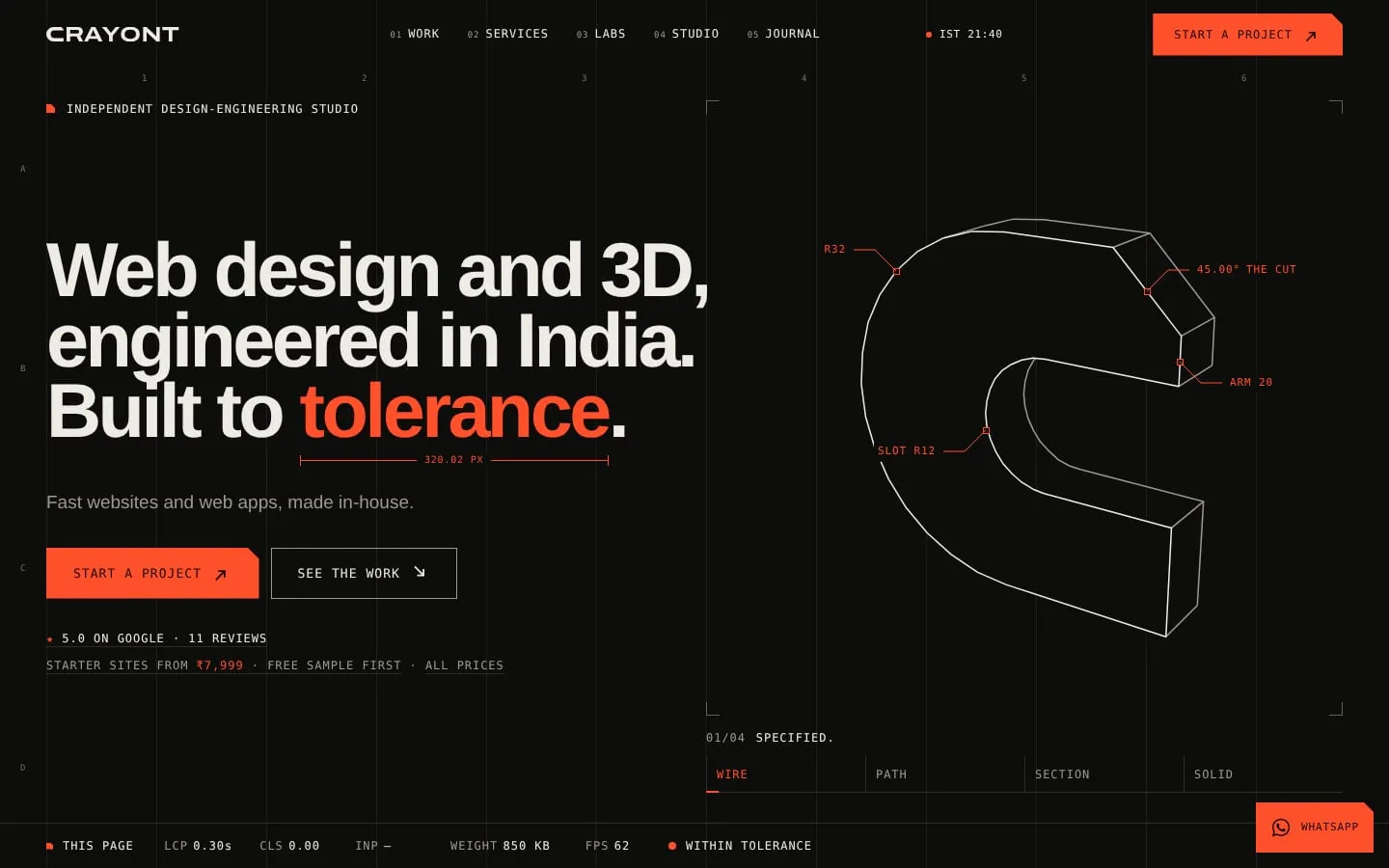
There’s more detail in 3D websites that still load in under two seconds.
Where the enquiry goes
A 3D view that ends with nothing is a demo. For manufacturers it should end in a request for quote that already carries what the buyer looked at:
- The product and part number.
- The variant, size or mounting option they had selected.
- Their quantity, application and deadline, from a short form.
- Their company and contact details, sent to the right person in sales and stored safely.
That turns “please send details” emails into enquiries your team can price straight away. If you use a CRM, the enquiry can go straight into it.
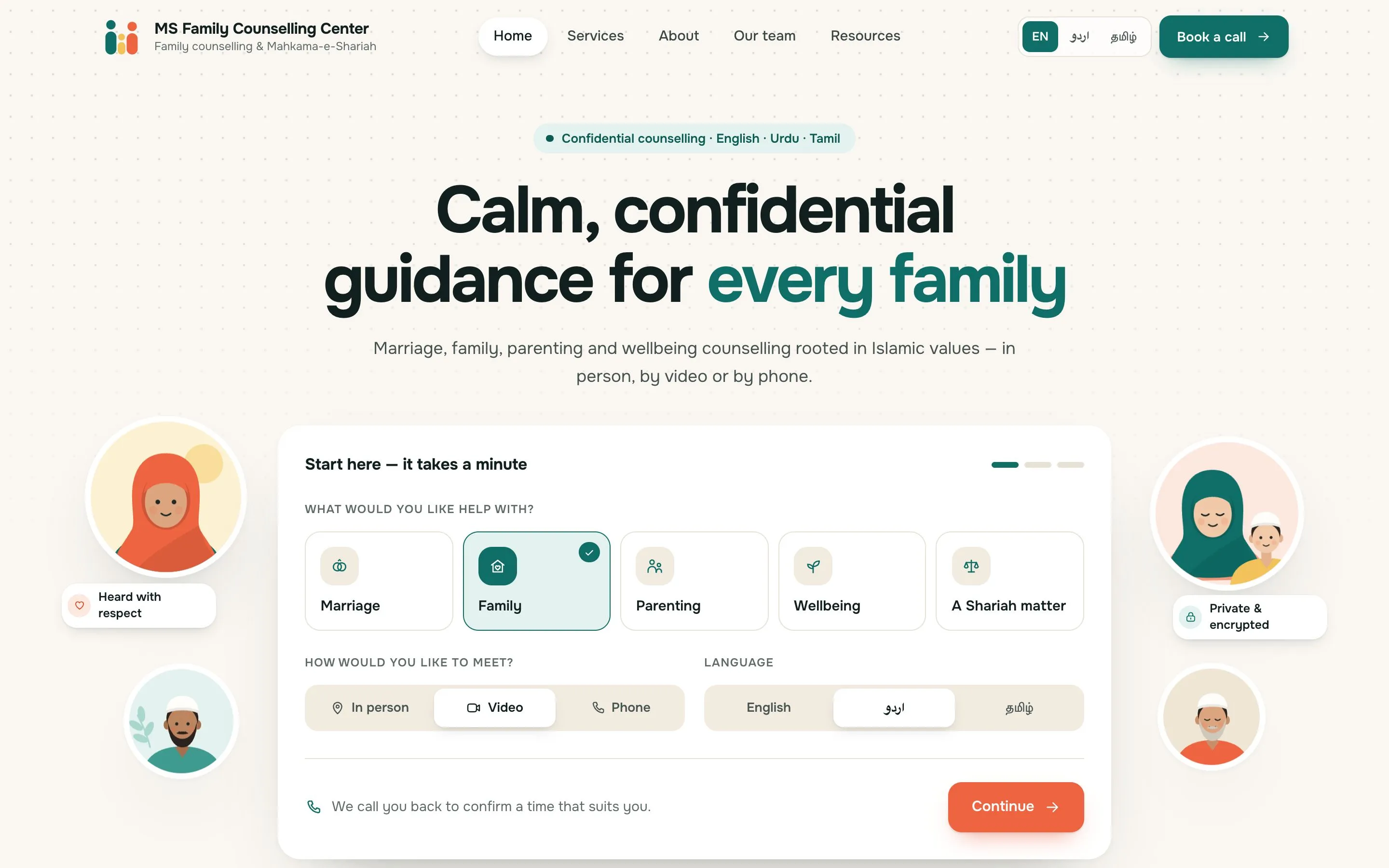
Home: three choices
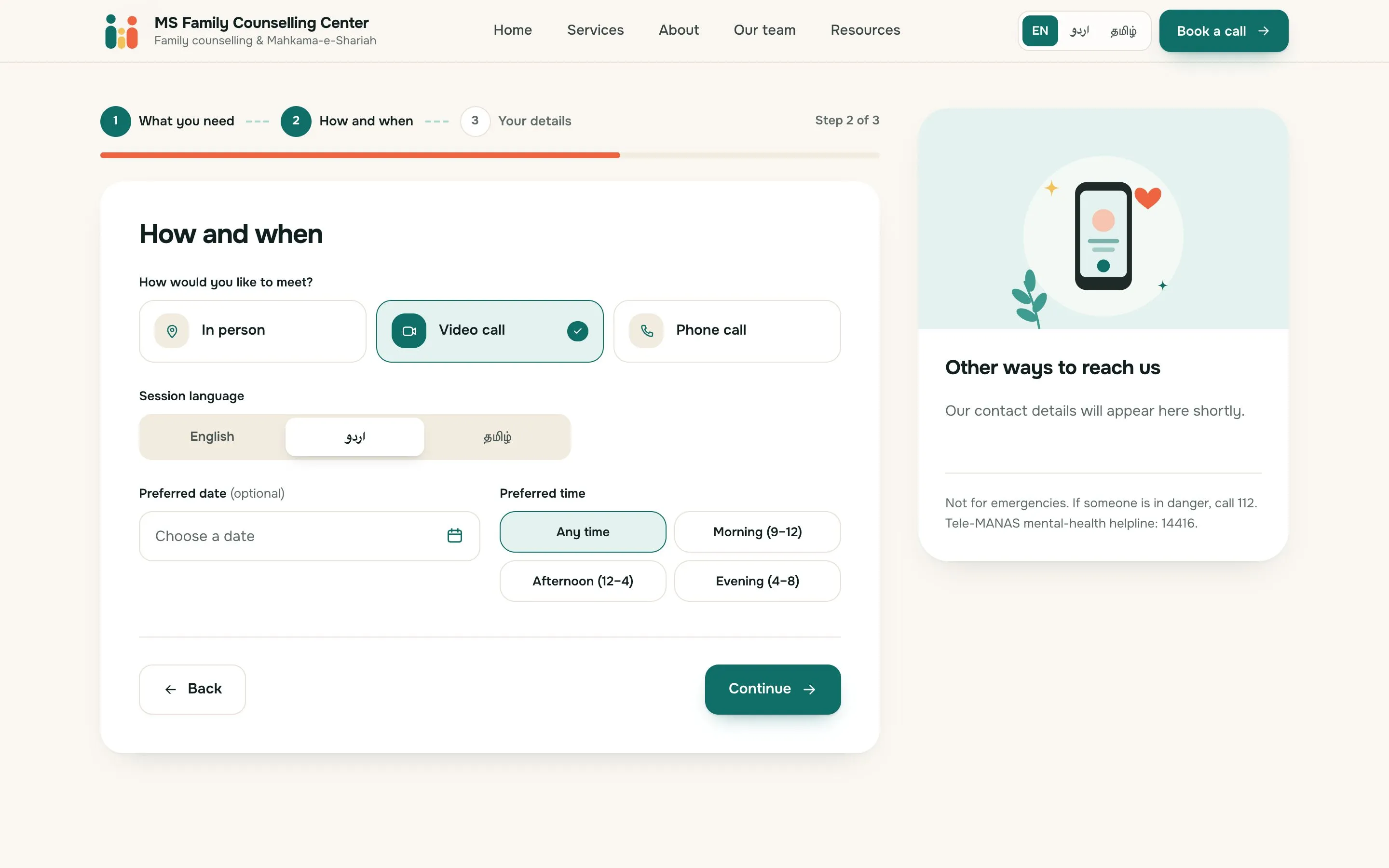
Booking: already filled in
What it costs
Our 3D and WebGL websites start at ₹1,50,000, fixed against a written spec. What moves the price above that:
| What changes | Why it matters |
|---|---|
| State of your CAD | A clean export is quick to prepare. Building a model from drawings or a sample is a separate job. |
| Number of products in 3D | The first product carries the set-up. Products that share parts and materials cost less each. |
| Views | A turntable and hotspots are simpler than an animated exploded view plus a cross-section. |
| Variants | Each size or option has to be modelled, tested and kept in sync with your spec tables. |
| Where enquiries go | An email is quick. A CRM or ERP connection takes integration work. |
| The rest of the site | Product pages, downloads, languages and a CMS for your team are part of the scope too. |
For a full breakdown, see how much a 3D website costs. For a site without 3D, our websites start at ₹60,000; all prices are on the services page.
Questions to ask any 3D website developer
- Can you work from our CAD files, and how will you protect what’s confidential?
- What will the page show before the 3D loads, and on phones that can’t run it?
- How large will the model be, and how do you keep it small?
- Which views will you build: exploded, hotspots, cross-section, variants?
- Where does an enquiry go, and does it carry the part and variant the buyer looked at?
- How do we add a new product later without coming back to you?
- What will the page measure on a mid-range phone, and will that be in the spec?
- Who owns the web models and the code at the end?
A one-page brief you can copy
Company: [name, what you make, who buys it]
Products for 3D: [which first, and how many in total]
Views needed: [turntable / exploded / hotspots / cross-section / variants]
3D files we have: [CAD format / render model / none]
What must stay confidential: [internals, dimensions, materials]
Where it lives: [current site URL / new site]
Enquiries should go to: [email / CRM / ERP], and include: [part, variant, quantity]
Who will add products later: [names or roles]
Speed target: [e.g. page usable in under 2 seconds on a mid-range phone]
Budget band: [range]
Launch date: [and why, e.g. a trade show]
How we work with Chennai companies
We’re Crayont, a two-founder design-engineering studio in Vellore. I (Riyaz) design and build the front end and the 3D. Salman builds the back end, the enquiry forms and the integrations. When a project needs a new model, a 3D artist joins and you’ll know who they are from day one.
Work with Chennai teams is remote: a call to start, a written spec, then a preview link you can open on your own laptops and phones every week and a short written update every Friday. The steps are on our process page.
To start
A call
Next
A written spec
Every week
A preview link
Open it on your own laptops and phones.
Every Friday
A short written update
See our 3D and WebGL websites page for Chennai, the full 3D and WebGL website service, or what we’ve built on the work page. When you have a product in mind, even roughly, send us the brief. You’ll get an honest yes, no or “start with one product” within a working day.
Questions people ask
- How much does a 3D website cost in Chennai?
- Our 3D and WebGL websites start at ₹1,50,000. The price depends on how many products go into 3D, the state of your CAD files, which views you need (exploded, cross-section, hotspots) and where enquiries have to go. It's fixed after a written spec.
- Can you use our CAD files?
- Yes. STEP, IGES, SolidWorks or similar exports are the usual starting point. We reduce them to a light web model and take out internal geometry you don't want public. If there's no CAD, a 3D artist builds a model, and you'll know who they are.
- Will our confidential design details be exposed?
- Only what you approve. The web model is a simplified copy, not your engineering file. We agree what's shown, at what level of detail, before anything goes online.
- Will 3D slow our website down?
- It doesn't have to. The page loads as normal HTML with a still image first. The 3D view loads afterwards, only on devices that can run it, and speed targets are written into the spec.
- Do you work with Chennai companies?
- Yes. We're based in Vellore and work with Chennai teams remotely: a kick-off call, a written spec, a preview link every week and a written update every Friday. A meeting in Chennai can be arranged.
Keep reading
All notes →- 3D websites for leather and footwear exporters in Vellore, Ambur and Ranipet: showing samples to buyers abroadLooking for 3D or WebGL website development in Vellore? How leather goods and footwear exporters in Ambur, Ranipet and Vaniyambadi can show samples to overseas buyers in 3D, what it takes, what it costs and a brief you can copy.
- Hiring Three.js and WebGL developers in India: how to check they can ship a real 3D websiteLooking to hire Three.js or WebGL developers in India? Freelancer, staffing firm or studio, the technical questions that separate demos from production work, a paid test you can copy and what it costs.
- 3D product configurators for Bengaluru brands: when they're worth it, how they're built, what they costLooking for a 3D or WebGL website developer in Bengaluru? When a product configurator is worth building, how a fast Three.js configurator works, what it costs and a brief you can copy.