Vellore7 min read
3D websites for leather and footwear exporters in Vellore, Ambur and Ranipet: showing samples to buyers abroad
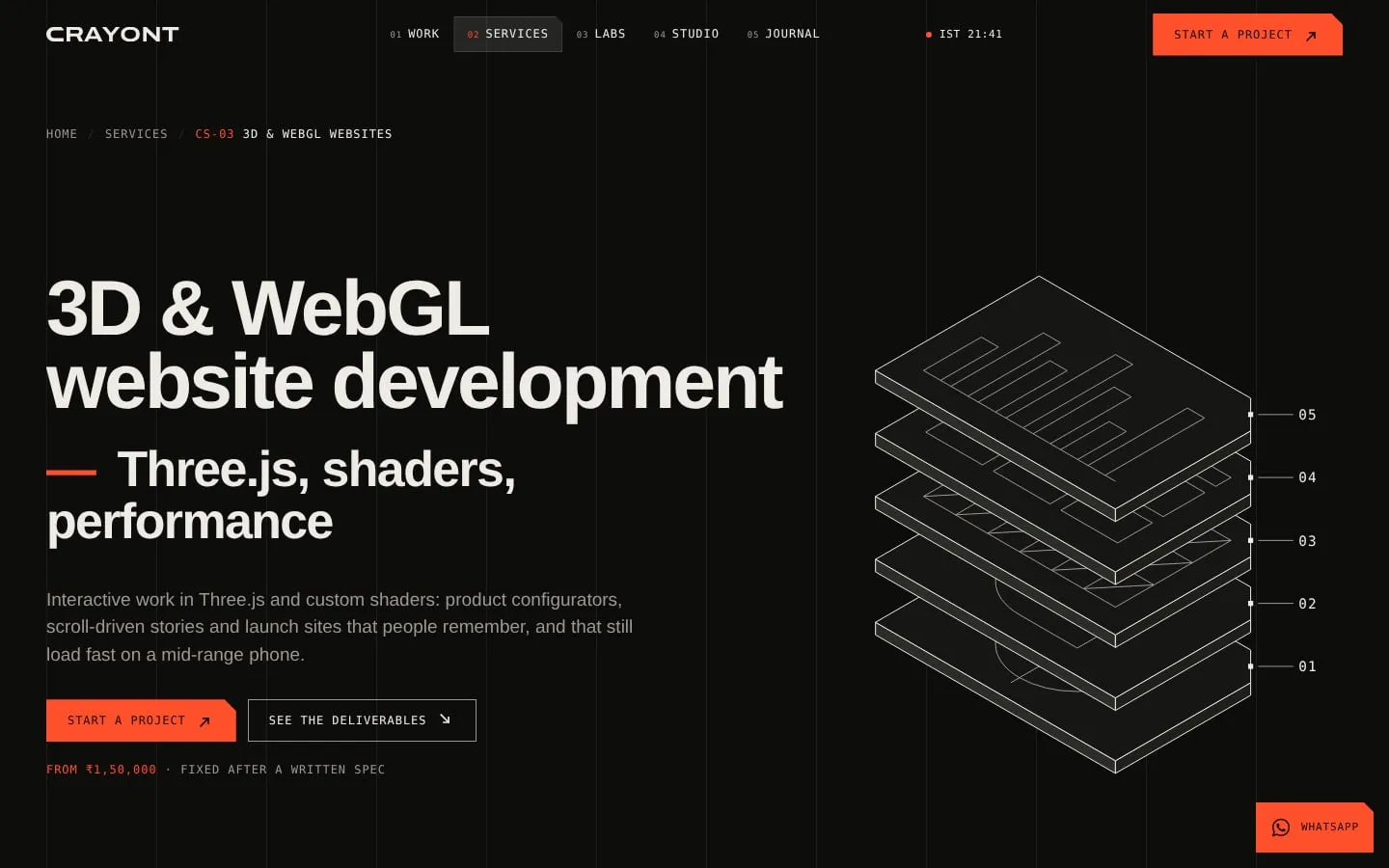
Looking for 3D or WebGL website development in Vellore? How leather goods and footwear exporters in Ambur, Ranipet and Vaniyambadi can show samples to overseas buyers in 3D, what it takes, what it costs and a brief you can copy.

Quick summary
- For an exporter, 3D is worth it when buyers abroad have to judge shape, construction and finish before they order samples. Photos on a white background rarely show that.
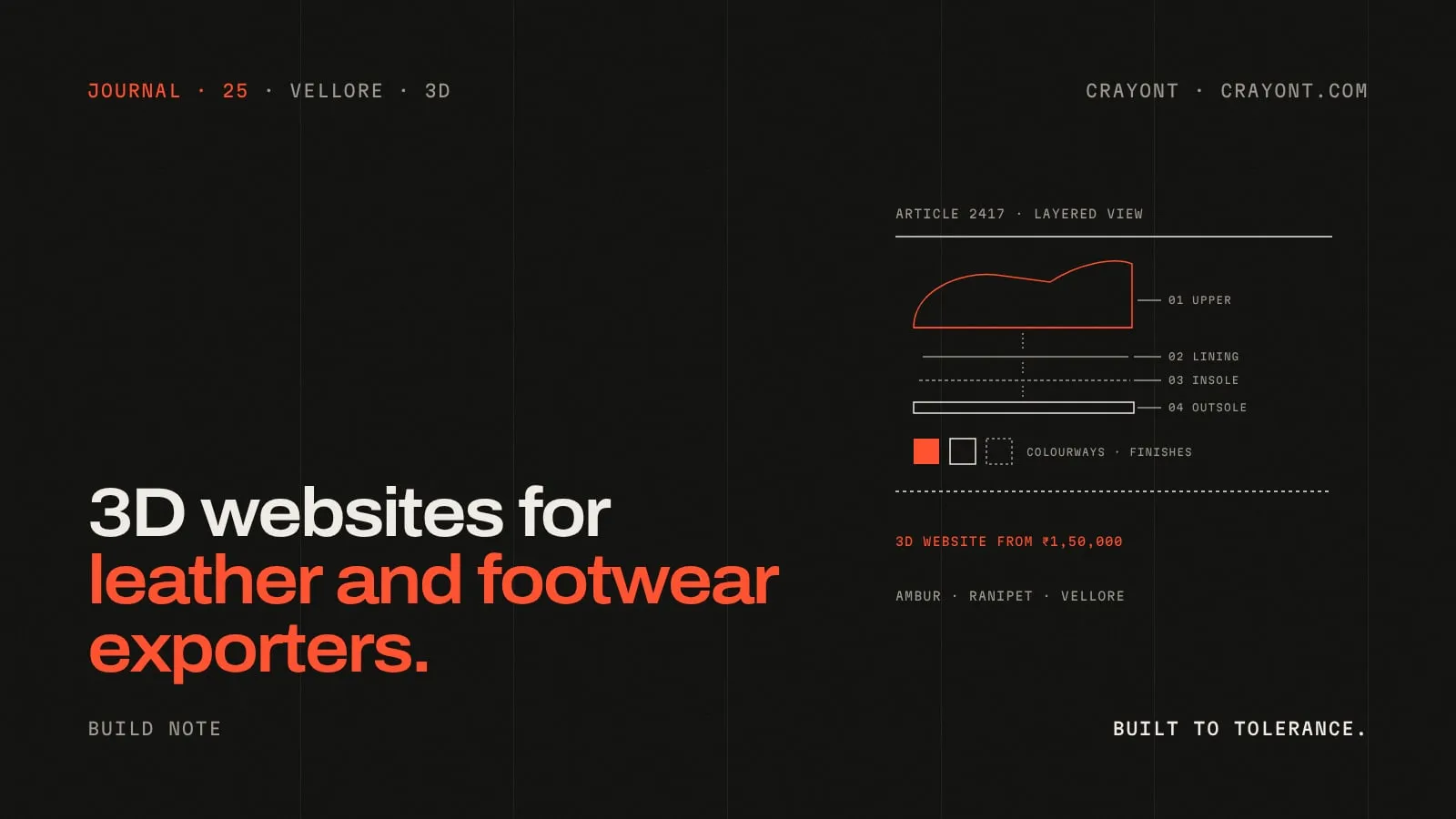
- The useful views are a 360° turn, colourway and leather-finish swatches, and a layered view of the construction, each with the article number and specs in normal HTML.
- Models can come from footwear CAD exports, a 3D artist working from your tech pack, or a photo scan of a finished sample.
- Unreleased collections can sit on private buyer pages that Google never sees, while the public site stays fast and searchable.
- Our 3D and WebGL websites start at ₹1,50,000, fixed against a written spec. International projects are quoted in USD, EUR or AED.
Search for 3D website development in Vellore and you’ll mostly find directory listings and B2B marketplace pages. That’s a gap, because the Vellore district and its neighbours are home to one of India’s best-known leather clusters. Tanneries, footwear units and leather-goods makers in Ambur, Vaniyambadi, Ranipet and Vellore sell to buyers in Europe, the Gulf and beyond, and many of those buyers judge a collection from a screen before they ask for a single sample.
This guide is for those exporters. It covers when 3D actually helps you win orders, which views to build, where the models come from, how to keep new collections private, what it costs and a brief you can send to any studio, including us.
When 3D is worth it for an exporter
A buyer abroad can’t pick up your shoe, bend the sole or feel the leather. Today they see photos, a PDF line sheet or a sample that took weeks to ship. 3D helps when it shortens that loop.
It’s usually worth building when:
- Buyers ask for more angles. If your team keeps sending extra photos of the heel, the welt or the inside of a bag, a 3D view answers those questions once.
- You offer many colourways or finishes. One model can show every colour and leather finish, instead of a photo shoot for each.
- Construction is your selling point. Goodyear welt, cemented or stitched soles, full-grain linings: a layered view shows the build quality that a flat photo hides.
- You’re between trade fairs. A collection page with 3D keeps working after the fair stand comes down.
It’s usually not worth it when you sell mostly commodity articles on price, or when your buyers only order repeats of styles they already know. Then a fast catalogue with sharp photos and a clear enquiry form is the better spend. We build those too, and our Vellore website development guide covers them.
The views that help buyers
Skip the spinning logo. These are the views that help a buyer decide.
A 360° turn
Drag to rotate, pinch to zoom. The buyer checks the profile, the toe shape, the heel height and the back, at their own pace. Keep the camera limited to useful angles so nobody ends up looking at the floor.
Colourways and finishes
Swatches under the model switch the leather colour, the finish (nubuck, patent, burnished, pull-up) and the lining. Each swatch carries its own name and code, so a buyer can write “article 2417 in tan pull-up” in their enquiry and mean the same thing you do.
A layered construction view
The upper, lining, insole, midsole and outsole separate on a tap, each with a short label. For bags and small leather goods, the same idea shows the panels, the reinforcement and the hardware. This is where you show what you make better than the next factory.
Hotspots
Numbered points on the model open a short note: the stitch type, the edge finish, the hardware supplier, the sole compound. Two or three good hotspots beat ten.
Specs in plain HTML
Article number, sizes, materials, MOQ and lead time sit next to the model as normal text, not inside the 3D. Buyers can copy them, translation tools can read them and Google can index them.
Where the models come from
You may already have more than you think.
- Footwear or leather-goods CAD. If your design team works in CAD, its 3D export is the best starting point. We reduce it to a light web model and set up the materials.
- A 3D artist working from your tech pack. If there’s no CAD, an artist builds the model from your tech pack, patterns and a physical sample. You’ll know who they are from the start.
- A scan of a finished sample. For a few hero articles, a photo scan captures the real leather grain. It needs cleaning up, but it looks true to the sample.
Leather is hard to fake in 3D. Grain, sheen and the way light falls across a crease are what make a model read as leather rather than plastic. We build the material from close-up photos of your actual leather, so the screen matches the sample the buyer eventually holds.
Keeping new collections private
Exporters often can’t show next season’s articles on a public website. You don’t have to choose between privacy and 3D:
- Public pages show your current range, your factory, certifications and how to start working with you. These are the pages that rank on Google.
- Private buyer pages sit behind a login or a private link, carry the
noindextag and stay out of search results. You decide which buyer sees which collection, and when. - The web model is a simplified copy, not your production file. Patterns and exact measurements stay with you.
Keeping it fast and readable to Google
A buyer in Milan on an office laptop and a sourcing agent at a fair on a phone should both get a page that works. The rules we build to:
- The page loads as normal HTML with a still image of the article first. The 3D library and model load only once the page is usable and the viewer is on screen.
- Models use glTF with compressed geometry and textures, and a size budget written into the spec.
- Slow phones, data-saver mode and visitors who prefer reduced motion get a designed still version instead of the 3D.
- The frame rate is capped and the scene pauses when it’s off screen, so laptops don’t spin their fans.
We go deeper on this in 3D websites that still load in under two seconds, and our Core Web Vitals checklist lists the numbers Google measures.
Where the enquiry goes
A 3D view that doesn’t end in an enquiry is decoration. Every article page should end in a sample request:
What the sample request does
- The form fills in the article number, colourway and finish the buyer was looking at.
- It asks the questions you'd ask anyway: quantity, target price band, delivery port and timeline.
- It goes to the right person's email, and optionally to WhatsApp, with the buyer's time zone noted so the reply lands in their working hours.
- Each request is recorded, so you can see which articles and colourways get the most interest.
What it costs
Our starting prices:
| What you need | Starting price |
|---|---|
| 3D and WebGL website | ₹1,50,000 |
| Website without 3D (up to 8 pages, CMS, SEO set-up) | ₹60,000 |
| Website redesign (with a full redirect map) | ₹90,000 |
| Web app or buyer portal | ₹2,50,000 |
International projects are quoted in USD, EUR or AED for the same scope. What moves a 3D price:
- How many articles go into 3D. Many exporters start with 6 to 12 hero articles and show the rest as photos.
- Where the models come from. Clean CAD exports cost less to prepare than modelling from scratch.
- Which views you need. A 360° turn with colourways is simpler than a full layered construction view.
- Private buyer pages. A login and per-buyer access add build time.
The full breakdown is in how much a 3D website costs.
Questions to ask any 3D website developer
- Can I open a live 3D site you built on my phone, on mobile data?
- How will you make the leather look like our leather?
- What does a slow phone see?
- Will the article number, specs and price band be HTML, outside the 3D?
- How will you keep unreleased articles out of Google?
- Who builds the models, and can I talk to them?
- Can my team add a new article or colourway without calling you?
- What size and speed budget will you write into the spec?
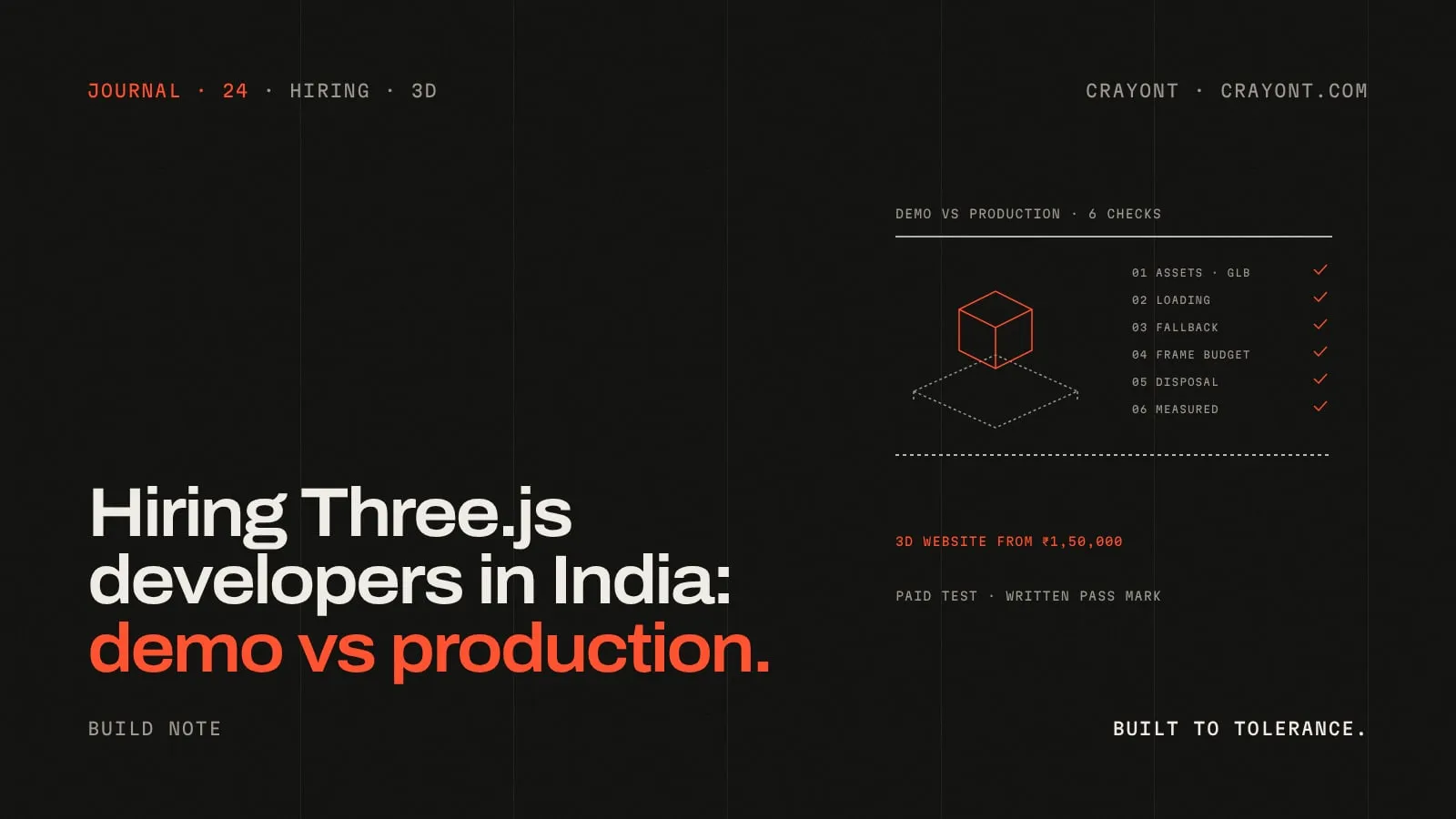
For the technical version of these questions, see hiring Three.js and WebGL developers in India.
A 3D view that doesn’t end in an enquiry is decoration.
A one-page brief you can copy
Company: [name, location, what you make]
Buyers: [countries, type of buyer: brand, retailer, agent]
Articles for 3D: [how many, and which ones]
Models: [CAD files / tech packs / samples only]
Views: [360° / colourways and finishes / layered construction / hotspots]
Private pages: [yes, for which collections / no]
Enquiry: [sample request form, email, WhatsApp, which person]
Languages: [English / others]
Current site (if any): [URL, and what's wrong with it]
Trade fairs coming up: [names and dates]
Budget band: [range]
Launch date: [and why that date]
How we work with exporters in the Vellore district
We’re Crayont, a two-founder design-engineering studio in Vellore. I (Riyaz) design and build the front end and the 3D in Three.js and GLSL. Salman builds the back end, the sample request forms, buyer logins and integrations. When a project needs new 3D models, a 3D artist joins and you’ll know who they are from day one.
Every project starts with a written spec that lists the articles, the views, the size budget, the speed target and the fallback. You get a preview link every week and a short written update every Friday. Because we’re close by, a kick-off meeting at your factory in Ambur, Ranipet, Vaniyambadi or Vellore is easy to arrange. The steps are on our process page.
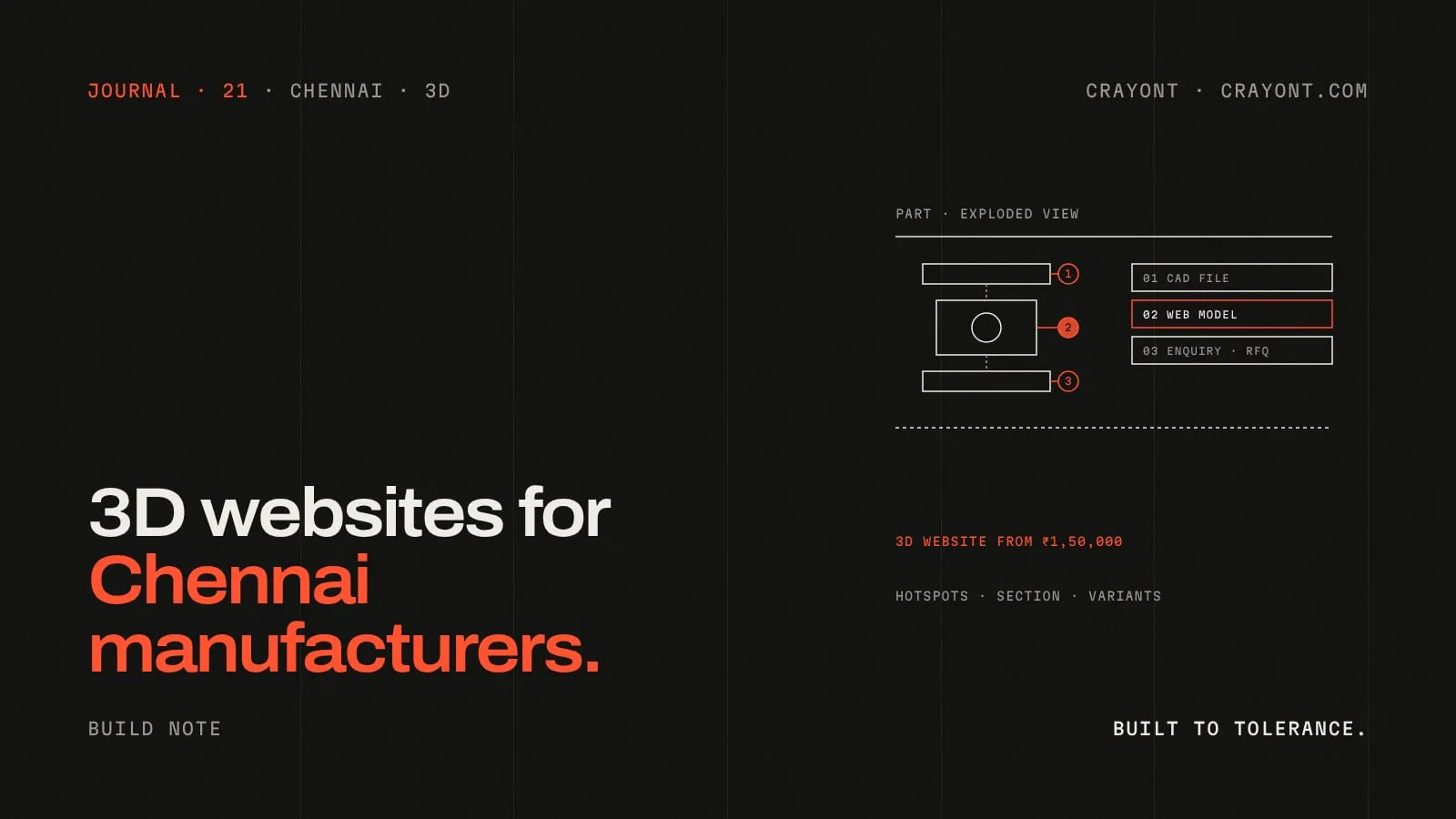
Suggested read3D websites for Chennai manufacturers: showing industrial products in 3D, from CAD file to enquirySee our 3D websites page for Vellore, the full 3D and WebGL website service, or what we’ve built on the work page. When you have a brief, even a rough one, send it to us. You’ll get an honest yes, no or “start with a few hero articles” within a working day.
Questions people ask
- How much does a 3D website cost in Vellore?
- Our 3D and WebGL websites start at ₹1,50,000. The price depends on how many articles go into 3D, where the models come from, which views you need and whether you need private buyer pages. It's fixed after a written spec.
- Do we need 3D models already?
- No. If your design team uses footwear or leather-goods CAD software, its 3D export is a good start. If not, a 3D artist can build models from your tech packs and samples, or we can scan a finished sample. You'll know who does the modelling from day one.
- Can buyers see the new collection before it's public?
- Yes. Unreleased articles can go on private pages behind a buyer login or a private link, kept out of Google. The public site shows only what you choose.
- Will 3D make the site slow for buyers in Europe or the Gulf?
- It doesn't have to. The page loads as normal HTML with a still image first, the 3D loads afterwards on devices that can run it, and the speed target goes into the spec.
- Can you visit our factory?
- Yes. We're in Vellore, so a visit to a factory in Ambur, Ranipet, Vaniyambadi or Vellore itself is easy to arrange, for a kick-off meeting or to photograph and scan samples.
Keep reading
All notes →- Hiring Three.js and WebGL developers in India: how to check they can ship a real 3D websiteLooking to hire Three.js or WebGL developers in India? Freelancer, staffing firm or studio, the technical questions that separate demos from production work, a paid test you can copy and what it costs.
- 3D websites for Chennai manufacturers: showing industrial products in 3D, from CAD file to enquiryLooking for 3D or WebGL website development in Chennai? How manufacturers can show parts, machines and assemblies in 3D on their website, what it takes, what it costs and a brief you can copy.
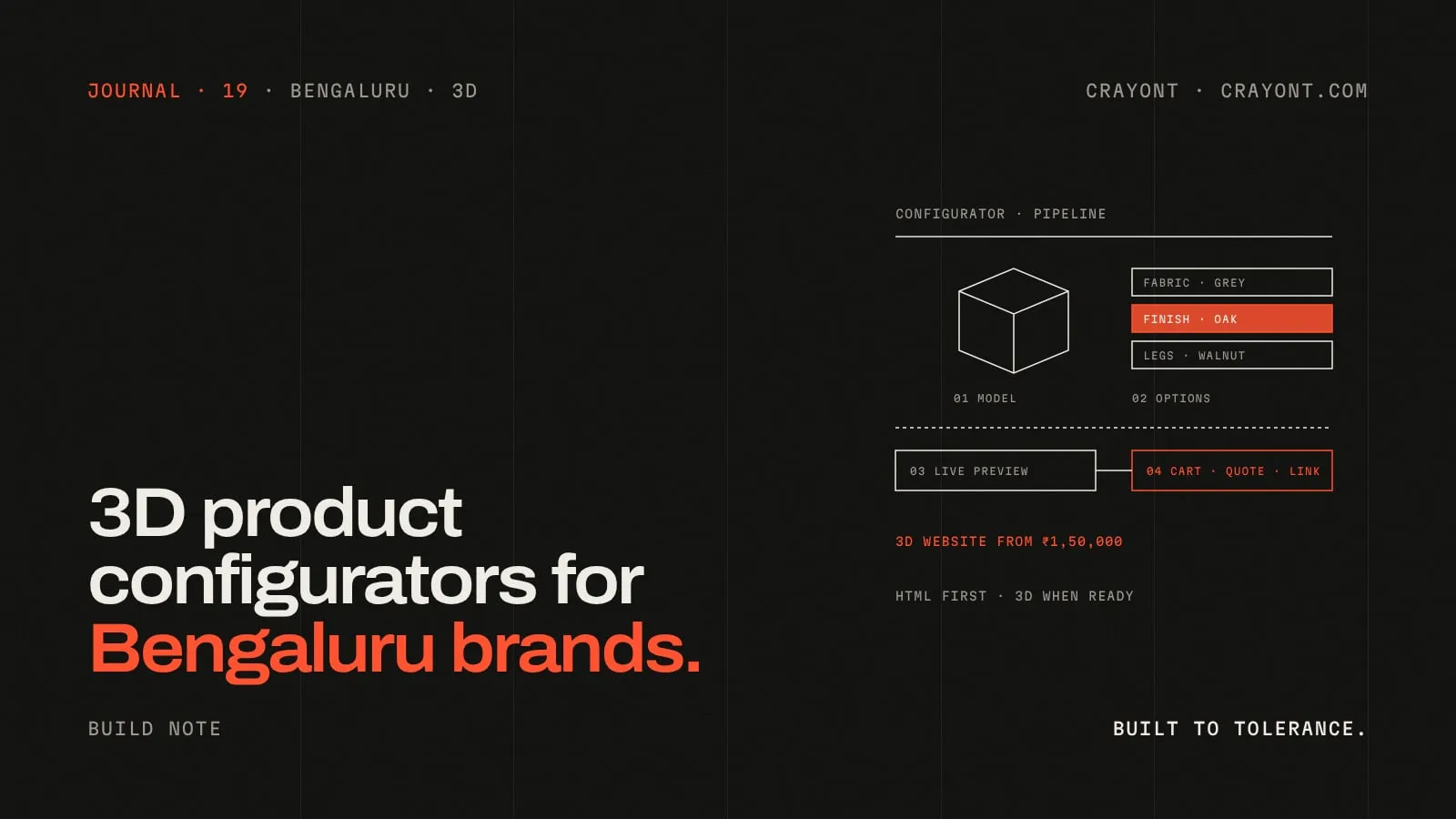
- 3D product configurators for Bengaluru brands: when they're worth it, how they're built, what they costLooking for a 3D or WebGL website developer in Bengaluru? When a product configurator is worth building, how a fast Three.js configurator works, what it costs and a brief you can copy.