Pricing6 min read
Website maintenance cost in India in 2027: what you're actually paying for each month
What website maintenance costs in India in 2027, split into the running costs you pay anyway and the work someone does each month. With a copyable monthly checklist, what we found when we checked our own site's code today, and when you don't need a maintenance plan at all.

Quick summary
- Website maintenance is two bills: running costs you pay whoever looks after the site (domain, hosting, paid plugins) and the monthly work (updates, backups, checks, small fixes). Ask every quote to split them.
- Our own care plan starts at ₹6,000 a month and includes monitoring, a monthly measured report, updates and small fixes. A Core Web Vitals audit with a fix list starts at ₹15,000 as a one-off.
- When we checked this site's own code on 19 November 2026, npm listed 19 packages with newer versions and 12 security advisories. Most were in build tools that never reach a visitor, one was in the framework itself. That is what a normal month looks like.
- A simple static site that changes twice a year may not need a monthly plan. A site that takes payments, orders or bookings does.
- Before you sign, ask who holds the domain, hosting and code accounts. They should be in your name, whoever maintains the site.
Website maintenance in India is two separate bills, and most quotes mix them up. One is running costs: the domain, hosting and any paid plugins, which you pay every year no matter who looks after the site. The other is work: someone updating the software, testing backups, checking the forms and payments still work, and fixing small things. That second bill is the one people actually mean by “maintenance”.
Our own care plan starts at ₹6,000 a month. Below is what that money should buy you from anyone, a checklist you can copy, what we found when I checked this website’s own code this morning, and when you don’t need a monthly plan at all.
When I searched for this topic, most pages gave a price table with three tiers and a long list of features. What almost none of them said is how to tell which tier your site needs, or what a normal month of maintenance actually finds. That’s what this post is about.
The two bills
Running costs are paid to the companies that keep your site online:
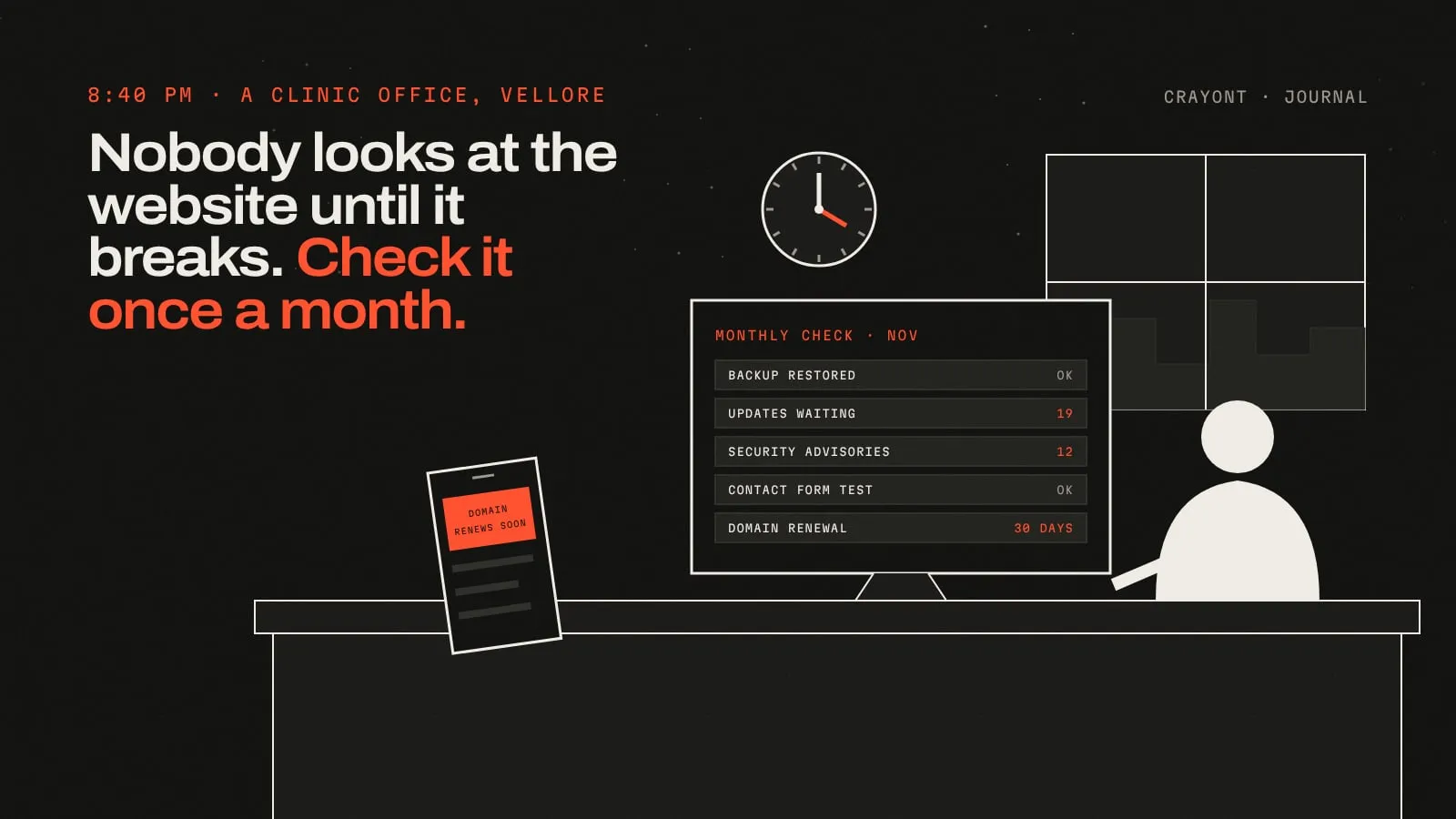
- Domain. A yearly renewal at your registrar. Check the renewal price, not the first-year offer, because they’re often different. And put a reminder in your own calendar. A lapsed domain takes the site down, and any email on that domain with it.
- Hosting. For a static site this can cost very little. Our own site runs on Cloudflare Workers, whose free plan allows 100,000 requests a day, and the paid plan starts at $5 a month. A WordPress site needs a server with PHP and a database, which is a different kind of bill.
- Paid plugins, themes, fonts and tools. Often yearly licences. Ask what happens to updates if a licence lapses.
The work is what someone does each month to keep the site safe, fast and working. That’s what a maintenance or care plan prices.
What a normal month actually finds
Maintenance sounds abstract until you see a real month. So this morning, 19 November 2026, I ran the two standard checks on the code behind crayont.com. This is a site we built ourselves in Astro and keep up to date.
npm outdated        # which packages have newer versions
npm audit --omit=dev  # known security advisories in what ships
The result: 19 packages had newer versions, and npm reported 12 security advisories (1 low, 4 moderate, 7 high).
That sounds alarming. Here’s what it means once you read the list:
- Most of the advisories were in tools that only run on a developer’s laptop or during the build: the local dev server, the deploy tool and the libraries under them. A visitor’s browser never touches them. They still get updated, because the build machine matters too, but they aren’t an open door into the live site.
- One advisory was in Astro itself, the framework that builds every page. A newer release already fixes it, so it goes on this month’s update list.
- The 19 outdated packages were mostly small version bumps: the framework, its Cloudflare adapter, Tailwind, GSAP, the deploy tool. Each update is a small change, but each one has to be built, checked on the pages that use it, and shipped.
This is a site with almost nothing running on the server, built and looked after by the people who wrote it, and a normal month still turns up a list. A site with a database, a dozen plugins and a payment gateway turns up a longer one. That’s the job maintenance is paying for: reading the list, deciding what matters, updating it safely, and checking nothing broke.
What should be in a maintenance plan
Whoever maintains your site, this is the minimum I’d expect each month. Copy it into your contract.
The monthly check
- Updates: framework, CMS, theme and plugins updated, built and checked on the pages they touch. Not just clicked 'update all' on the live site.
- Backups: taken automatically, stored somewhere other than the server, and test-restored at least once a quarter. A backup nobody has restored is a hope.
- Uptime: monitored, with an alert to someone who will act on it, not just an email nobody reads.
- Forms and payments: a real test enquiry sent and received, and a test payment run if the site takes money.
- Speed: the key pages checked on a phone against Core Web Vitals, and anything that got slower explained.
- Renewals: domain, certificates and paid licences tracked, with a reminder at least 30 days out.
- Small fixes: a set number of small content or layout changes included, written down so nobody argues later.
- Report: one short written page each month: what was checked, what changed, what's coming up.
The report is the part most people skip, and it’s the part that tells you whether you’re getting anything for the money. If you can’t see what was done this month, assume nothing was.
What changes the price
Two sites can both be “a business website” and need very different amounts of care. These are the things that move the number:
- What runs on the server. A static site has very little: pages are built once and served as files. WordPress has the core, a theme, plugins, PHP and a database, each with its own updates.
- How many plugins or integrations there are. Every plugin is someone else’s code with its own release schedule. Payment gateways, booking tools and CRMs each need testing after updates.
- Whether the site takes money or bookings. If a broken checkout costs you orders, it needs checking every month, not every year.
- How often the content changes. A menu that changes weekly needs either an editor your team can use or a developer on call.
- Who built it. Maintaining a site you didn’t build starts with understanding it. That’s why we audit first.

The same small business, two ways
Here’s how the stack changes what you sign up for.
Less to maintain
A static site with a simple editor, no plugins and a WhatsApp button
Pages are built ahead of time and served as files. There's no database or plugin to patch on the server, so a monthly check is short.
More to maintain
A WordPress site with a page builder and 15 plugins
Each plugin updates on its own schedule and can clash with the others. That's fine if someone checks it every month, and risky if nobody does.
Neither is wrong. WordPress makes sense when your team edits a lot of content every day and already knows it. Just budget for the care it needs, and make sure someone is actually doing it.
If you're still choosing the stackAstro vs Webflow vs WordPress: which builds the faster site?A worked example with our prices
All of these come from our published price list.
- A clinic gets our starter business website for ₹12,999, one time. It has services, timings, Google Maps and a WhatsApp button, and changes a few times a year.
- If it adds the care plan at ₹6,000 a month, that’s ₹72,000 a year, more than five times what the site cost to build.
For that clinic, I’d say that’s too much. A site like that doesn’t need someone every month. It needs the domain and hosting in the owner’s name, a reminder for renewals, and a developer to call when the timings change.
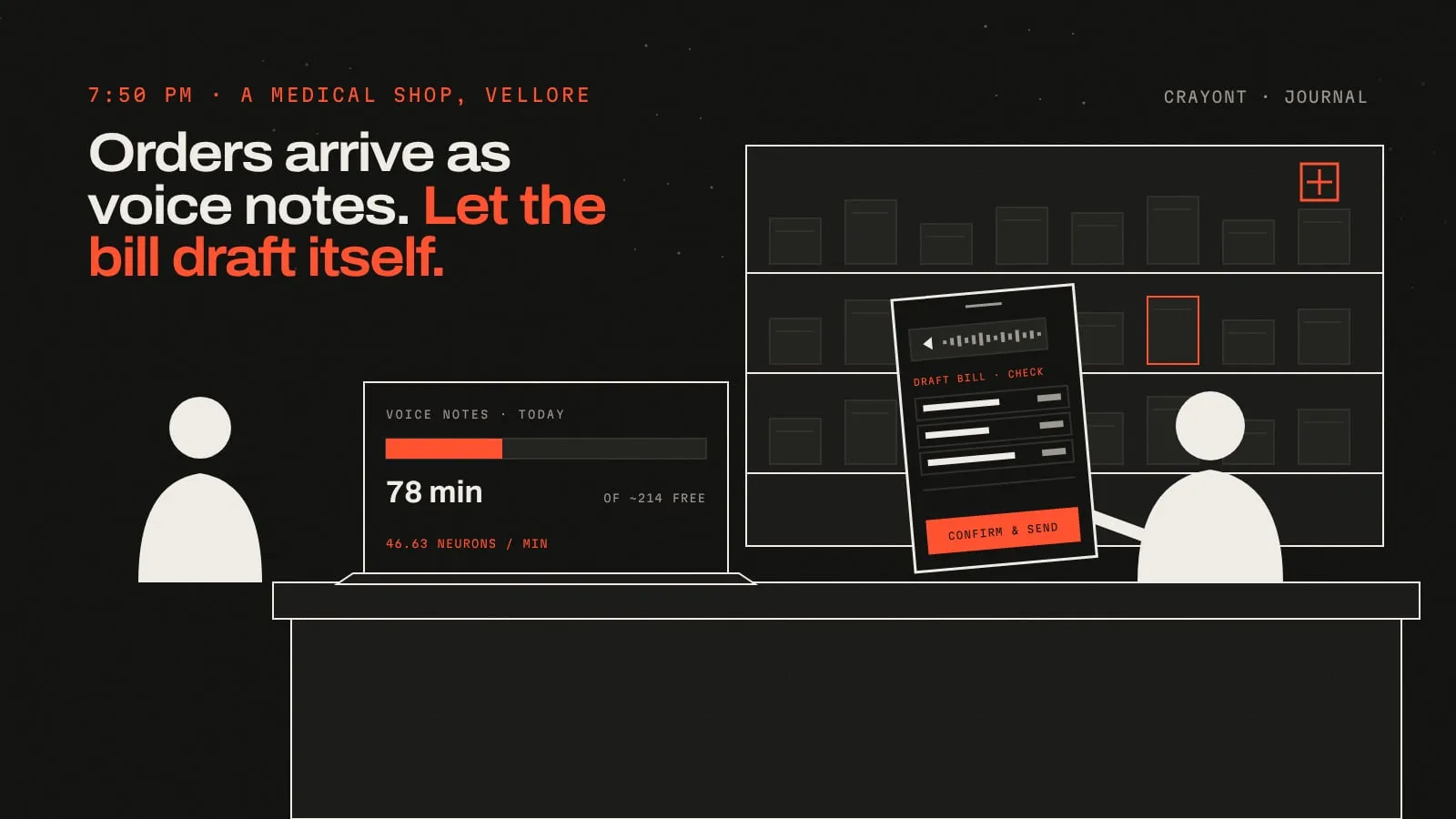
Now take a print shop that takes orders and payments online, like the one above. A broken checkout costs real orders every day it goes unnoticed. There, a monthly plan is cheap insurance, and the speed checks pay for themselves.
When you don’t need a monthly plan
Be honest with yourself here. Skip the monthly plan if all of these are true:
- The site is static: no logins, no database, no plugins running on the server.
- It doesn’t take payments, orders or bookings.
- The content changes a few times a year.
- The domain and hosting are in your name, and you have a reminder for renewals.
Then a check once or twice a year, plus paying for edits when you need them, is enough. If the site is already slow or something feels off, a one-off Core Web Vitals audit (from ₹15,000) gives you a fix list without a monthly commitment.
Questions to ask before you sign
- Whose name are the domain, hosting and code accounts in? They should be yours. If the maintainer disappears, you need to be able to hand the site to someone else.
- What exactly is done each month? Ask for a sample report.
- How are updates tested? “We click update” isn’t an answer. Ask whether changes are checked before they go live.
- How many small changes are included, and what counts as small?
- What happens if the site goes down at 9 PM on a Saturday? Who gets the alert, and how fast do they act?
- How do you leave? A plan you can’t exit cleanly isn’t a plan, it’s a lock-in.
If you’re in Vellore or anywhere else and want a second opinion on your current setup, send us the link. Salman, my co-founder, handles the back end, so we’ll look at the server side as well as the pages, and tell you plainly whether you need us every month or just once.
Questions people ask
- How much does website maintenance cost in India in 2027?
- It depends on what the site does. Running costs (domain, hosting, any paid plugins) are paid yearly whoever maintains it. The work is usually priced monthly. Our care plan starts at ₹6,000 a month for monitoring, a monthly measured report, updates and small fixes. A site with payments, orders or logins needs more checking than a five-page brochure site, so it costs more.
- What should a website maintenance plan include?
- At minimum: software and plugin updates, backups that are actually test-restored, uptime monitoring, a check that the contact form and payment flow still work, a speed check on a phone, domain and certificate renewal reminders, and a short written report each month that says what was done.
- Do I need a monthly maintenance plan for a small website?
- Not always. A static site with no plugins, no logins and no payments, that changes a couple of times a year, can often be checked once or twice a year and edited when needed. Pay monthly when the site makes money directly, takes payments or bookings, or runs on software that needs regular security updates.
- Is WordPress maintenance more expensive than a static site?
- Usually, yes, because there is more to keep updated: the core, the theme and every plugin, each on its own release schedule, plus a database and a server. A static site built with a tool like Astro has none of those running on the server, so there is less to patch. It still needs its build tools updated now and then.
- Does Crayont maintain websites it didn't build?
- Yes, after a one-off audit. We check the site first, write down what's wrong and what it would take to keep it healthy, and quote the care plan from that.
Keep reading
All notes →- AI tool ideas for small businesses in 2027: five small tools you can build, and what they cost to runFive small AI tools to build for shops, clinics and tuition centres in 2027: voice notes to bills, enquiry replies in Tamil and English, price-list search, enquiry sorting and read-aloud updates. With the model for each and the running cost worked out from Cloudflare's published prices.
- A website for a tuition or coaching centre in Tamil Nadu, 2027: what parents look for, and what it costsWhat a tuition or coaching centre website in Tamil Nadu needs in 2027: the five things parents check, the page outline to copy, how to show results without upsetting families, and real prices from ₹7,999.
- GSAP website animations in 2027: how to keep them fast, readable and calmWhat GSAP really costs a page in 2027, measured on our own site: script weight per plugin, long tasks with and without motion, and the five rules we use so scroll animations never hide text or shift the layout.