Why I started Crayont
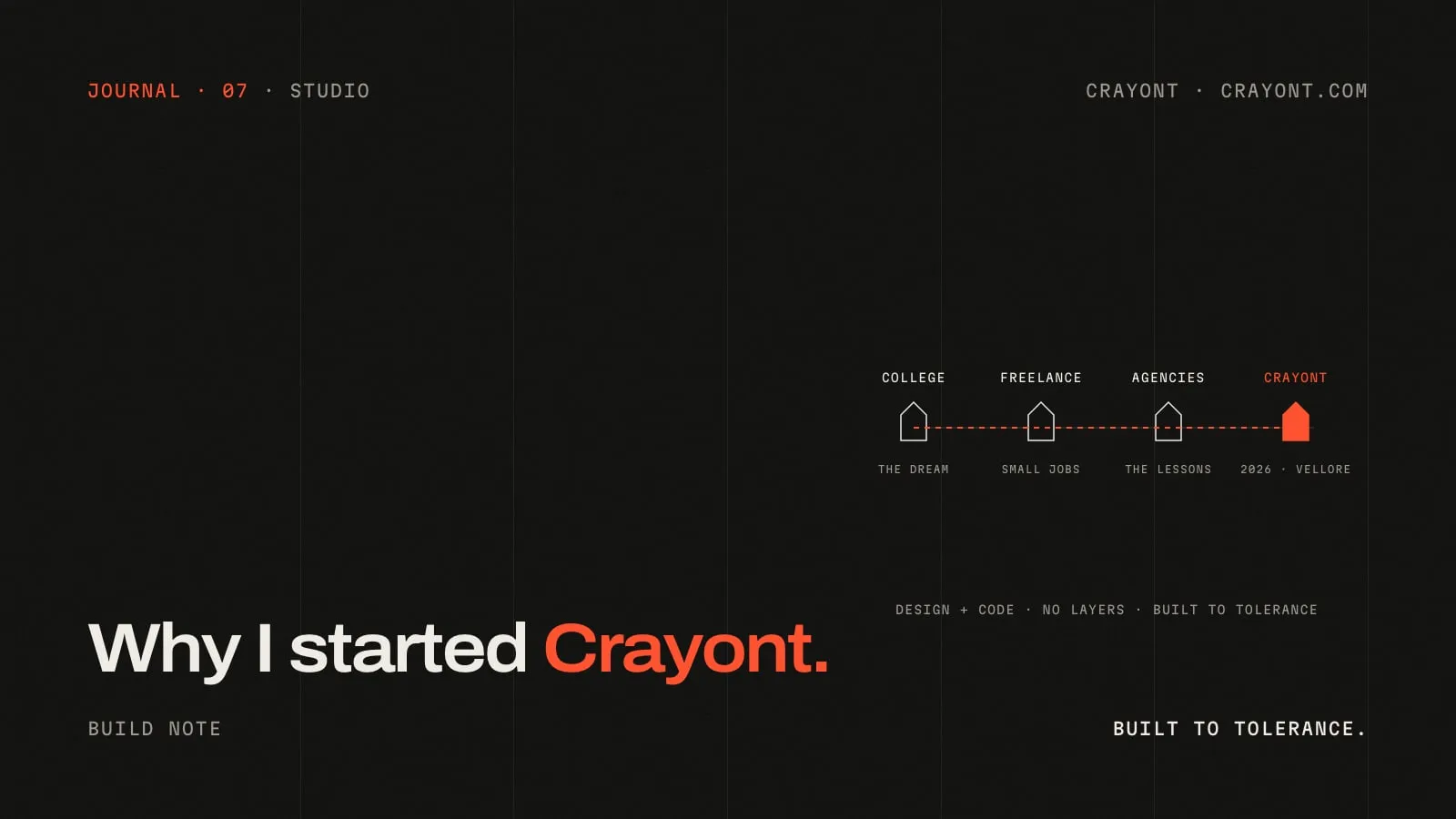
How Crayont began: a dream from college, years of small freelance jobs and agency work, and why a small studio in Vellore, Tamil Nadu designs and codes everything itself.
TL;DR · Key takeaways
- Crayont exists because I wanted to be the person who designs the interface and also writes its code, so nothing is lost between the two.
- Freelancing taught me what clients actually need; agency work taught me where good work gets lost. The studio is built to fix the second with the first.
- It is a small studio with no layers, based in Vellore, working with clients in Chennai, Bangalore and abroad.
- New tools have changed what a small studio can ship. That is the bet: small, senior, measured, and better than the big shop down the road.
Every studio has a story it tells about itself. Most are written after the fact to sound inevitable. This one is short, and it’s true.
A dream from college
I knew in college that I wanted my own studio. Not a big company, not a job title, just a place where the work was mine to get right. I didn’t know what it would be called or what exactly it would make. I knew I liked two things that people usually keep apart: designing how something looks and feels, and writing the code that makes it real.
Most courses and most companies make you choose. Designers hand over files; developers build what they’re given. I never wanted to choose, and I spent the next years finding out whether that was naive or an actual advantage.
Freelancing: learning what clients need
The first real work was small freelance jobs. A page for a shop, a form for a school, a fix on a site somebody else had abandoned. Nothing you’d put in a portfolio, and all of it useful.
Freelancing teaches you things a job never does. Clients don’t want a website; they want the phone to ring, the form to arrive, the shop to sell. They don’t care which framework you used. They care whether it works on their own phone and whether you answer when something breaks. I learned to write things down before starting, to give a price and keep it, and to test on the cheap Android phone the client’s customers actually use.
Two of those early relationships turned into proper projects later: a printing company that needed an e-commerce site, and a madrasa that needed a donation platform. Both are on the work page now, live, with their numbers.
Agencies: learning where good work gets lost
Then I worked inside agencies. That taught me the other half.
Agencies have talented people and real clients, and still the work gets lost between hands. The design is good until it meets the developer’s deadline. The code is good until the design is “simplified” to fit it. The client talks to an account manager who talks to a project manager who talks to whoever is free that week. By the time a site ships, nobody feels responsible for the whole thing, and the numbers, if anyone measures them, are nobody’s fault.
I don’t say this with bitterness. I learned more about process, clients and deadlines in agencies than anywhere else. But I kept seeing the same loss, and it always happened at the handover between design and code. That is exactly the gap I’d refused to choose a side of in college.
Why “design-engineering”
So the studio had to be built around one idea: the person who designs the interface also writes its code. No handover, no translation, no “that’s not possible in development”. When I design a motion, I know what it costs in milliseconds, because I’ll be the one paying it. When I write the code, I know why every pixel is where it is, because I put it there.
That’s what “design-engineering studio” means on this site. It isn’t a fashionable phrase; it’s the job description.
The second idea followed from the first: measure everything. If one person is responsible for the whole build, that person can be held to numbers. Load time, layout shift, accessibility, search rankings after a migration. Every project here ships with its numbers, and “Built to tolerance” is the promise that they’re inside the limits we agreed in writing before design started.
Small, no layers
Crayont is small on purpose. The people who design your interface also build it: front-end, motion and 3D, back-end, data and integrations. There is no account manager, because the people you talk to are the people doing the work. When a project needs a 3D artist or a copywriter, they join by name.
We’re based in Vellore, Tamil Nadu. Most of our clients are in Chennai, Bangalore and abroad, and the work runs the same way for all of them: a written spec, a fixed price, a build link every week, and a measured handover. How the studio works has the details.
Why now
For most of my career, a small studio could not compete with a thirty-person agency on the sheer amount of work a project needs. That has changed. The tools available now, from frameworks like Astro to the AI assistants we use for the repetitive parts of building, mean a small team of senior people can ship what used to take a floor of juniors, and ship it faster and cleaner.
What the tools can’t do is have taste, take responsibility, or answer the phone in month six. That’s the part we sell. The bet behind Crayont is that a small, senior, measured studio, using every tool available, produces better work than a large one, and that clients will notice the difference in the numbers.
What comes next
Client work pays for the studio; the studio also builds its own products. The first ones are in Labs, and the same rules apply to them: shipped, measured, honest about what’s ready and what isn’t.
If you’ve read this far and you’re planning a website, a web app or something in 3D, you now know exactly who you’d be working with. Send us the brief. You’ll get a reply from the people who’d build it, within a working day.
FAQ · Questions people ask
- What does the name Crayont mean?
- Nothing. It is a coined word chosen because it was short, unused and easy to say. The studio's identity comes from the work and the standard, not from the name.
- Who works at Crayont?
- The people who design and code every project, directly. Specialists join by name when a project needs one, and you know who they are from day one.
- Where is Crayont based?
- Vellore, Tamil Nadu, India. Most projects are with clients in Chennai, Bangalore and abroad, run remotely on IST hours with calls scheduled around the client's time zone.